Hello Silent Muses,
Life and actually working on said game is taking up time because time.
I'm placing on hold until after the season, so come on back on 1/5, and have a good holiday season until then.
Monday, December 8, 2014

Tuesday, November 25, 2014
Ia, Ia, a Pirate's Life for Me!!
So I've decided to start using the Blog to keep ideas and STUFF that I've made. First up is
PIRATES OF LENG
This was a creation of mine from...too long ago, really. It was a Game Chef idea, with some challenges such as "use these constraints on your system" and it just kinda...clicked in a weird, wild weekend. It's my motivation for making games--this worked out pretty well--imagine if I didn't limit myself? I keep looking at it and thinking I should really clean it up, so...maybe one day.
So yeah--have a free random game! Hopefully more will be inbound...soon...ish. Maybe.
So please, read it, enjoy it, play it--and if you do let me know!
PIRATES OF LENG
This was a creation of mine from...too long ago, really. It was a Game Chef idea, with some challenges such as "use these constraints on your system" and it just kinda...clicked in a weird, wild weekend. It's my motivation for making games--this worked out pretty well--imagine if I didn't limit myself? I keep looking at it and thinking I should really clean it up, so...maybe one day.
So yeah--have a free random game! Hopefully more will be inbound...soon...ish. Maybe.
So please, read it, enjoy it, play it--and if you do let me know!
Monday, November 24, 2014
Random: Friggin' Cold & Movies where Ed Harris Plays God
So we got hit by wintery doom here last week (not Buffalo , with sub zero temperatures no matter which thermometer you use (well, not Kelvin...). This is in part why I didn't post last week--quite frankly, it kind of sucked my ability to do anything. It was that cold where your inner caveman says "No, seriously, we gotta get out of this or we're all going to die!" cold.
This was the first real cold this season, and it always hits me the same way. It's a bit depressing, the cold--makes things darker, feels lonelier and quieter.
And it got me thinking about how crappy life has to be in this world I've made. How that chill just smothers everything you do, and the quiet realization in my head of "ooo...weather just got set to hard mode". It made me realize that there was a lot of potential in that as a core of the people of this world--these were people who had lived for generations with that monster outside the walls.
No wonder things are getting bad in the Sanctum. It's been two hundred years with that chill desperation.
Then I saw this:

A new works cited--Snowpiercer. A lovely little movie about a bunch of survivors on a train in a frozen wasteland where there's no chance of survival in the frozen wastes and highly stratified society.
...sound familiar?
It also gives us the ever-popular line of Captain America talking about how he knows what baby tastes like, so there's that).
Mind, things aren't quite as bad for the poor people in my Tower--there's room to move, goods and materials, and trade. The same issues exist though--the system is built to keep a select few on top and a bunch of "unfortunates" on the bottom. Yes, this does lead to revolutions and violence from time to time, and yes this could easily read as a metaphor for current society, the writings of a number of Russian gentlemen, and whatever else you want to see. However, since I feel that RPG's aren't the best media for grandstanding and soap-boxing, I'll leave that to you and your table.
On a final note, I'm pondering expanding the blog to be a bit more useful to me as well in a few other ways. This will depend again on time and my ability to decipher blog controls, but...we'll see.
Have a great Thanksgiving this week!
This was the first real cold this season, and it always hits me the same way. It's a bit depressing, the cold--makes things darker, feels lonelier and quieter.
And it got me thinking about how crappy life has to be in this world I've made. How that chill just smothers everything you do, and the quiet realization in my head of "ooo...weather just got set to hard mode". It made me realize that there was a lot of potential in that as a core of the people of this world--these were people who had lived for generations with that monster outside the walls.
No wonder things are getting bad in the Sanctum. It's been two hundred years with that chill desperation.
Then I saw this:
A new works cited--Snowpiercer. A lovely little movie about a bunch of survivors on a train in a frozen wasteland where there's no chance of survival in the frozen wastes and highly stratified society.
...sound familiar?
It also gives us the ever-popular line of Captain America talking about how he knows what baby tastes like, so there's that).
Mind, things aren't quite as bad for the poor people in my Tower--there's room to move, goods and materials, and trade. The same issues exist though--the system is built to keep a select few on top and a bunch of "unfortunates" on the bottom. Yes, this does lead to revolutions and violence from time to time, and yes this could easily read as a metaphor for current society, the writings of a number of Russian gentlemen, and whatever else you want to see. However, since I feel that RPG's aren't the best media for grandstanding and soap-boxing, I'll leave that to you and your table.
On a final note, I'm pondering expanding the blog to be a bit more useful to me as well in a few other ways. This will depend again on time and my ability to decipher blog controls, but...we'll see.
Have a great Thanksgiving this week!
Monday, November 10, 2014
Garden Floors
Kind of a quick one this week.
Of all the needed elements to survive in the Sanctus, light may be the most important. With the skies covered by leaden clouds, natural light is just a fairy tale.
Outside of the Noble Estate Floors, it is the Garden Floors that are considered the most beautiful and valuable real estate within the Sanctus. These vital floors are the source of food for everyone within the Tower. Acres of soil were brought in from the best fields in the world, combined with the most reliable and sturdy seed the pre-Impact world had available.
Exiting the lift onto a Garden Floor is a bit surreal--suddenly stepping out onto a large field of wheat or a crop of trees is a bit jarring. Even more alien is the lighting--most of the eldritch costs of the Tower are for the expensive and ornate engines that run the Sunglobes--creations of crystal and gold that can emulate the light of the sun enough for crops to grow. Compared to the eternally shady regions of most floors, using only candle or hearth or witchlight to keep themselves illuminated, Garden Floors are brilliantly lit and warm.
It's always easy to spot the farmers of the Tower, being the rare few that tend to have actual tans. It is required by law for every man, woman, and child to visit the Garden Floors at least once a month for health (normally doing small duties and easy labor for that day)--a day most look forward to. Even though none of the people in the Tower now remember a sunny day, the feeling of warm light on your face is something that is remembered in the bones.
Every day farmers tend their fields and use the alchemical fertilizers and stimulants to let life thrive. Knowing that a failed crop could mean the death of thousands, the work is serious and detailed. The very best of Hortomancy and plant enchantments are used to keep the crops successful and healthy. Wood Elementals are summoned regularly to make sure that blights are stopped before they begin and the very core natures of the crops can be maximized to their penultimate effect. These crops have special properties to literally bless and keep the masses as healthy as they can, making sure the needed elements of life are imbued in each grain and fruit, or to create new varieties for noble consumption or Illuminated experiment.
As it's all artifical, the growing seasons tend to be constant, with a floor growing food for three months, taking two months of restoring the land with alchemicals, and then starting over again. Surpluses can be sold to other nearby floors, and most have their specialized
The majority of floors is used for potatoes, legumes and beans, and other staple crops. Wheat, oats, and rice are common enough for mass consumption but rare enough for them to be an addition to the diet and not the staple. It must be said that more of the wheat crops go to production of beers and whiskeys than may be strictly needed, but many would consider a stiff drink a necessity in these dark times. Fruit trees and vinyards bring rare treasures like apples, grapes, and citrus fruits. A few noble fields are even used to keep a steady supply of rarities such as tobacco and poppies for the elites to enjoy. Of course, in the dark places a diet of mushrooms and
IDEAS FOR GAMES
1. A blight has hit the garden, and crops are going to be slim. The other nearby floors have instituted a rough quarentine of the floor and the people the garden supports to "protect their own crops", and two village floors are already bracing for long months of near-starvation. The floor's mayor is worried for his life, the gangs are already starting to steal food and supplies, and anarchy and panic loom in the air. Can the characters help these people survive? Can they convince the other floors to help? Was the blight just bad luck, or was something more sinister underway?
2. The Hortomancers summoned a major elemental for the vinyard of Baroness Skaldi. She demanded the very best of her orchard for this year's vintage and...well...the Elemental broke its bonds. Now it's attacking anyone who goes out to tend the crops. The farmers and the Illuminatist are doing their best to keep this embarassing fiasco from reaching the Baroness's ears, but time is running out and there's a wild spirit-creature taking over an entire floor. They need this taken care of quietly.
3. It's a fine time in Cell 783, The floors are having their annual celebration of surviving another year and the famous spirit competition. The floors work to make the finest of their goods and competition is fierce. Sure, there's normally a few brawls and an occasional riot, but when master farmer and brewer Hartlett is found dead in the middle of the corn field, things take a darker twist. No one is going to murder a man to win the Best Whiskey of the Year award...would they?
Of all the needed elements to survive in the Sanctus, light may be the most important. With the skies covered by leaden clouds, natural light is just a fairy tale.
Outside of the Noble Estate Floors, it is the Garden Floors that are considered the most beautiful and valuable real estate within the Sanctus. These vital floors are the source of food for everyone within the Tower. Acres of soil were brought in from the best fields in the world, combined with the most reliable and sturdy seed the pre-Impact world had available.
Exiting the lift onto a Garden Floor is a bit surreal--suddenly stepping out onto a large field of wheat or a crop of trees is a bit jarring. Even more alien is the lighting--most of the eldritch costs of the Tower are for the expensive and ornate engines that run the Sunglobes--creations of crystal and gold that can emulate the light of the sun enough for crops to grow. Compared to the eternally shady regions of most floors, using only candle or hearth or witchlight to keep themselves illuminated, Garden Floors are brilliantly lit and warm.
It's always easy to spot the farmers of the Tower, being the rare few that tend to have actual tans. It is required by law for every man, woman, and child to visit the Garden Floors at least once a month for health (normally doing small duties and easy labor for that day)--a day most look forward to. Even though none of the people in the Tower now remember a sunny day, the feeling of warm light on your face is something that is remembered in the bones.
Every day farmers tend their fields and use the alchemical fertilizers and stimulants to let life thrive. Knowing that a failed crop could mean the death of thousands, the work is serious and detailed. The very best of Hortomancy and plant enchantments are used to keep the crops successful and healthy. Wood Elementals are summoned regularly to make sure that blights are stopped before they begin and the very core natures of the crops can be maximized to their penultimate effect. These crops have special properties to literally bless and keep the masses as healthy as they can, making sure the needed elements of life are imbued in each grain and fruit, or to create new varieties for noble consumption or Illuminated experiment.
As it's all artifical, the growing seasons tend to be constant, with a floor growing food for three months, taking two months of restoring the land with alchemicals, and then starting over again. Surpluses can be sold to other nearby floors, and most have their specialized
The majority of floors is used for potatoes, legumes and beans, and other staple crops. Wheat, oats, and rice are common enough for mass consumption but rare enough for them to be an addition to the diet and not the staple. It must be said that more of the wheat crops go to production of beers and whiskeys than may be strictly needed, but many would consider a stiff drink a necessity in these dark times. Fruit trees and vinyards bring rare treasures like apples, grapes, and citrus fruits. A few noble fields are even used to keep a steady supply of rarities such as tobacco and poppies for the elites to enjoy. Of course, in the dark places a diet of mushrooms and
IDEAS FOR GAMES
1. A blight has hit the garden, and crops are going to be slim. The other nearby floors have instituted a rough quarentine of the floor and the people the garden supports to "protect their own crops", and two village floors are already bracing for long months of near-starvation. The floor's mayor is worried for his life, the gangs are already starting to steal food and supplies, and anarchy and panic loom in the air. Can the characters help these people survive? Can they convince the other floors to help? Was the blight just bad luck, or was something more sinister underway?
2. The Hortomancers summoned a major elemental for the vinyard of Baroness Skaldi. She demanded the very best of her orchard for this year's vintage and...well...the Elemental broke its bonds. Now it's attacking anyone who goes out to tend the crops. The farmers and the Illuminatist are doing their best to keep this embarassing fiasco from reaching the Baroness's ears, but time is running out and there's a wild spirit-creature taking over an entire floor. They need this taken care of quietly.
3. It's a fine time in Cell 783, The floors are having their annual celebration of surviving another year and the famous spirit competition. The floors work to make the finest of their goods and competition is fierce. Sure, there's normally a few brawls and an occasional riot, but when master farmer and brewer Hartlett is found dead in the middle of the corn field, things take a darker twist. No one is going to murder a man to win the Best Whiskey of the Year award...would they?
Wednesday, October 29, 2014
Now I Have a Magical Boomstick, Ho, Ho, Ho
Spellarms are a modification of earlier "magical wands" from the pre-industrialization period. These wands--specialized spell-casting foci used to aim elemental energy--were known and feared, but not terribly reliable. It took a master mage to craft a wand capable of inflicting damage in combat, and as it relied on a well-focused mind, it left a magician standing still and glaring at a specific target, normally only causing unbearable pain instead of actual damage (mind, for some that was a feature, not a bug).
Only after the Portable Casting Engine was built was there a reliable way to improve this wand. First came the Elemental Lance. Originally large and bulky cannons were only possible and unreliable, but over the centuries technology and metaphysics has been improved enough for man-portable spell-locks can be made.
Lances work by taking a burst of eldritch energy (from the PCE) and funnelling it into a small plug of alchemicals imbued with angelic runes. This creates an explosion of elemental energy, which is then funneled through a pointer of spell-reactive wood or metal. This focuses and charges the bolt, which then explodes out towards the target the shooter is focused on (yes, it is possible to do 'trick shots' where the shooter is pointing lance away from the target and hits them anyway, but that does decrease range and effectiveness).
If the shot is "perfect" the elemental charge will strike the target, meaning a fire-shot can cause a target to ignite, etc. However, since this bolt can be "bent" by metal, other meta-reactant materials on the target or shooter, warding, etc., this normally just means the target is hit by a surge of eldritch energy. Lances do not penetrate skin, they cause "Shuddering", twisting the flesh and bone of the target, Getting shot causes massive bruises, broken bones, and rent flesh, and is normally noted as being "painfully cold".
As PCE's allow warding against these weapons, spell-locks were considered useful but not a complete game-changer in the arts of war and murder. No, for that it would take a few more centuries of development, when the monks of Lenshai developed a way to mechanically replicate the "dark cries" of the book of Sephaun the Blind. The Hex-Lock or "Curser" is a different and much more terrifying weapon.
PCE's and lances both work using elemental mechanics. Cursers work on sepheriophic intonations of eldritch, more precise and focused, less controlled. These curses--based supposedly on the sounds of angels--were able to pierce through the wards. Even worse, their resultant castings could cause horrendous results--turning the target to a block of salt, covering the subject in boils, blindness and worse could happen. Hex-locks didn't require plugs, but still need a PCE to provide the initial spark of energy. As well, Hex-locks need a period of 'penance' to allow time to discharge all of the eldritch energy safely--otherwise it increases odds of the device backfiring or exploding entirely.
Cursers are lethal, but not always to the target--an unlucky shooter or one who wavers in concentration for a moment can have the spell backlash on themselves. This, along with the unsettling nature of the Curses themselves, makes them less popular than lances.
Only after the Portable Casting Engine was built was there a reliable way to improve this wand. First came the Elemental Lance. Originally large and bulky cannons were only possible and unreliable, but over the centuries technology and metaphysics has been improved enough for man-portable spell-locks can be made.
Lances work by taking a burst of eldritch energy (from the PCE) and funnelling it into a small plug of alchemicals imbued with angelic runes. This creates an explosion of elemental energy, which is then funneled through a pointer of spell-reactive wood or metal. This focuses and charges the bolt, which then explodes out towards the target the shooter is focused on (yes, it is possible to do 'trick shots' where the shooter is pointing lance away from the target and hits them anyway, but that does decrease range and effectiveness).
If the shot is "perfect" the elemental charge will strike the target, meaning a fire-shot can cause a target to ignite, etc. However, since this bolt can be "bent" by metal, other meta-reactant materials on the target or shooter, warding, etc., this normally just means the target is hit by a surge of eldritch energy. Lances do not penetrate skin, they cause "Shuddering", twisting the flesh and bone of the target, Getting shot causes massive bruises, broken bones, and rent flesh, and is normally noted as being "painfully cold".
As PCE's allow warding against these weapons, spell-locks were considered useful but not a complete game-changer in the arts of war and murder. No, for that it would take a few more centuries of development, when the monks of Lenshai developed a way to mechanically replicate the "dark cries" of the book of Sephaun the Blind. The Hex-Lock or "Curser" is a different and much more terrifying weapon.
PCE's and lances both work using elemental mechanics. Cursers work on sepheriophic intonations of eldritch, more precise and focused, less controlled. These curses--based supposedly on the sounds of angels--were able to pierce through the wards. Even worse, their resultant castings could cause horrendous results--turning the target to a block of salt, covering the subject in boils, blindness and worse could happen. Hex-locks didn't require plugs, but still need a PCE to provide the initial spark of energy. As well, Hex-locks need a period of 'penance' to allow time to discharge all of the eldritch energy safely--otherwise it increases odds of the device backfiring or exploding entirely.
Cursers are lethal, but not always to the target--an unlucky shooter or one who wavers in concentration for a moment can have the spell backlash on themselves. This, along with the unsettling nature of the Curses themselves, makes them less popular than lances.
Monday, October 27, 2014
Give that old time Religion: Faith and the Clergy
Ahhh, religion. Always kind of a hassle and kind of a really fun idea in most games. On one hand, religion is a core component of most of humanity's life--especially historically. On the other, it's a topic filled with pitfalls and bad turns that can ruin the concept.
Part of the problem is, to paraphrase someone else's wisdom, RPG's tend to work best when they take their ideas off the back of a truck by the docks, no questions asked. Yes, I know there's games out there that REALLY build their world, creating a completely original concept or focus on alien worlds forged from new ideas. My own opinion, however, has been that RPG's need a groundwork of familiarity to work best. Fantasy works because you can tell anyone playing "it's fantasy" and while there might be some big questions regarding magic and dragons, everyone's pretty sure what the story's going to involve--swords, rangers, a good chance of the classic races, some spell casting, yadda yadda. Sure, we might need to find out if we're doing Martin or Tolkien or Howard, but we're all pretty sure that no one's going to be declaring "I aim my AK-47 at the orc and call in a missile strike from the F-28's". We need something familiar, but not played out.
(What? I said "pretty sure".)
Added to this is the real-life baggage about religion in general. I've played with people with all manner of beliefs, ranging from "true believer" to "actively nonplussed by religions in general". Personally, I love dealing with religion in game, but it should be an element that you can ditch in your games if it's not going to work in your group. I've had both believers and athiest get annoyed when they have to deal with religious matters in game for their own reasons.
Done right, religion can be a great character motivator. Done poorly, it's a random stall on your character doing things, or kicks you out of the immersion when you hear that everyone is going to the Smatholoic church on Smunday to worship Xeexus Krista. Done really poorly, and it's an element that you can't ignore without completely ripping out major chunks of the game. Basically, in the stew of a game, religion is a habanaro pepper--it should be a spice, not the main courser, and removed with little impact if you want it.
If you couldn't tell by now, I'm grabbing from just about everything for Baroque-punk, and that includes for the religious elements as well. The main ingredient is going back to something closer to ancient Grecian and Roman beliefs. Added to this is healthy dose of Jewish lore and Old Testament structure. For the day to day issues, the Clergy is there to handle marriages and divorces and births and deaths, and sure there's a holy day where you should go to the church to praise the Heironophim and the Creatrix but at the end of the day it's a "functional" faith. The Clergy is highly literate and scholastic--they record day to day happenings (in case it becomes important enough to enter the Scrolls of History), they keep folks thinking about helping their fellow man, and they don't worry too much about events outside of terrestrial ones (Zha keeps miracles quiet and subtle? Probably for a reason--let's not bother the Supreme Deity with our petty questions on how the gears work and just enjoy the show). There are places to worship and sacrifice to appease the gods and hope for a holy break, but the open Temples are fairly quiet on the issues of sorcery and even the afterlife ('yes, there's an afterlife, but we're not quite positive what's going on because no one's come back to talk to us about it). The Temples are there to keep society going, not answer deep questions about life, the universe, and everything.
...That's what the Mystery Cults are for.
If your character wants to get into ritualism and learn a spell or two (at this point just to say they can...) or really delve into arcane matters, these secret societies are the place to be. Considering that there are powers out there that are close enough to divine for horseshoes, the Clergy and Society in general don't really want you thinking about occult matters like angels and demons, thank you. Just come in, sing a few hymnals, and try not to think about it too much. No, only those that show the knack can find their way into these cults, where they can discuss deep matters of theology. Also, maybe make a few political connections, but that's purely secondary I assure you...
Before you ask, yes, the Clergy does pay attention to these Mysteries, and does review what they're trying to do. So yes, there's something filling the game-standard "Inquisition" role, but they're not burning witches so much as they're reviewing what you're teaching and whose working with who. In situations this gets bad, well...there's other orders for that to handle things. What? You think the Clergy's going to let one group be judge, jury, and executioner?? That would be crazy!!
Part of the problem is, to paraphrase someone else's wisdom, RPG's tend to work best when they take their ideas off the back of a truck by the docks, no questions asked. Yes, I know there's games out there that REALLY build their world, creating a completely original concept or focus on alien worlds forged from new ideas. My own opinion, however, has been that RPG's need a groundwork of familiarity to work best. Fantasy works because you can tell anyone playing "it's fantasy" and while there might be some big questions regarding magic and dragons, everyone's pretty sure what the story's going to involve--swords, rangers, a good chance of the classic races, some spell casting, yadda yadda. Sure, we might need to find out if we're doing Martin or Tolkien or Howard, but we're all pretty sure that no one's going to be declaring "I aim my AK-47 at the orc and call in a missile strike from the F-28's". We need something familiar, but not played out.
(What? I said "pretty sure".)
Added to this is the real-life baggage about religion in general. I've played with people with all manner of beliefs, ranging from "true believer" to "actively nonplussed by religions in general". Personally, I love dealing with religion in game, but it should be an element that you can ditch in your games if it's not going to work in your group. I've had both believers and athiest get annoyed when they have to deal with religious matters in game for their own reasons.
Done right, religion can be a great character motivator. Done poorly, it's a random stall on your character doing things, or kicks you out of the immersion when you hear that everyone is going to the Smatholoic church on Smunday to worship Xeexus Krista. Done really poorly, and it's an element that you can't ignore without completely ripping out major chunks of the game. Basically, in the stew of a game, religion is a habanaro pepper--it should be a spice, not the main courser, and removed with little impact if you want it.
If you couldn't tell by now, I'm grabbing from just about everything for Baroque-punk, and that includes for the religious elements as well. The main ingredient is going back to something closer to ancient Grecian and Roman beliefs. Added to this is healthy dose of Jewish lore and Old Testament structure. For the day to day issues, the Clergy is there to handle marriages and divorces and births and deaths, and sure there's a holy day where you should go to the church to praise the Heironophim and the Creatrix but at the end of the day it's a "functional" faith. The Clergy is highly literate and scholastic--they record day to day happenings (in case it becomes important enough to enter the Scrolls of History), they keep folks thinking about helping their fellow man, and they don't worry too much about events outside of terrestrial ones (Zha keeps miracles quiet and subtle? Probably for a reason--let's not bother the Supreme Deity with our petty questions on how the gears work and just enjoy the show). There are places to worship and sacrifice to appease the gods and hope for a holy break, but the open Temples are fairly quiet on the issues of sorcery and even the afterlife ('yes, there's an afterlife, but we're not quite positive what's going on because no one's come back to talk to us about it). The Temples are there to keep society going, not answer deep questions about life, the universe, and everything.
...That's what the Mystery Cults are for.
If your character wants to get into ritualism and learn a spell or two (at this point just to say they can...) or really delve into arcane matters, these secret societies are the place to be. Considering that there are powers out there that are close enough to divine for horseshoes, the Clergy and Society in general don't really want you thinking about occult matters like angels and demons, thank you. Just come in, sing a few hymnals, and try not to think about it too much. No, only those that show the knack can find their way into these cults, where they can discuss deep matters of theology. Also, maybe make a few political connections, but that's purely secondary I assure you...
Before you ask, yes, the Clergy does pay attention to these Mysteries, and does review what they're trying to do. So yes, there's something filling the game-standard "Inquisition" role, but they're not burning witches so much as they're reviewing what you're teaching and whose working with who. In situations this gets bad, well...there's other orders for that to handle things. What? You think the Clergy's going to let one group be judge, jury, and executioner?? That would be crazy!!
Thursday, October 23, 2014
On Failure, Death, and Danger
So I've begun pondering mechanics. There's a lot of things I want to deal with, but one in general is "how easy is it to die?"
One of the hardest parts of tabletop is the balance of success vs. failure. Let's take the classic opening of "Raiders of the Lost Ark" as an example. Indy gets through a few traps, looses a few NPC's, tries to grab the golden head but doesn't put (at all) enough sand on there, and barely escapes a giant boulder. Sadly, he looses the head to his hated rival and Frenchman, Belloq.
Reviewing the scene, Indy fails...a lot. He steps on traps, almost dies way too many times on a tenured salary, and ends up loosing the MacGuffin he's out there to get in the first place. He should be a goner. However, since we know the movie is not titled "Dr. Marcus Brody and the Incredible Amount of Clean-up, International Apologies and Work Finding a Substitute when a Professor Dies Mid-Semester Raiding Cultural Landmarks", we also know that Indy's not in any actual peril. Oh, it looks it, but we know. Plot Armor.
Of course, in a game, this is something of a challenge. What if Indy rolled badly and got shot by poisonous darts? What if he botches his athletics roll and has to choose between "smushed" and "trapped behind 800 pound boulder--roll to not starve"?? Sure, Harrison could roll up another character, but that's time wasted that could be used to play a game--a few minutes for some games, a full night for others...
In short, death is a terrible fail state for a game. If it's ok for Hollywood Blockbusters to wink and nod at the "ooo, the star could die at any moment!", then I'm ok with it too. So we do what Hollywood does--you only die if it makes a good story. In short, we're giving the power of life and death of a character over to said player.
Now, don't get me wrong--just because you can't die doesn't mean you can't fail.
Basically, the mechanics are doing "anti-Awesome points". FATE, WFRP, White Wolf's Willpower (to a degree) all have some kind of usable resource that says "this is how many times you can be awesome/cheat death/etc/" The mechanics I have right now say "you can always be awesome, no matter what the dice say--but that doesn't mean you'll win."
Hence, the Danger Pool.
Danger Pool will be a number from 0 ("no danger here!") to...however deep it needs to go. Every Scene will have a Pool with a starting number ("how much danger are we in now??") and a Loss Level. If the Pool hits that Loss number, than you've lost the scene--the bad guys get away, or Belloq grabs the idol, or...
If you fail a roll, you can always buy up successes by throwing points into the Danger Pool. If you roll really well, you can drop the Danger Pool. Or you can drop it by giving yourself consequences--equipment fails or gets dropped, you take a punishing wound, or in the worst case die dramatically (the not-quite titled "Noooooo!!!" rule). But you always need to keep sharp, because the Danger Pool will always increase as time passes--take too long fighting those goons and it doesn't matter how good you look doing it--the bad guy still wins.
Be deciding the victory and failure states of a scene, we set specific goals and drive the players (and characters) to do what they need to do, and give them a way to win die rolls and look as awesome as they want but still giving them the option to fail.
For me, this is a different way to look at games, and simulation in general. It's motivating me. Let me know what you think.
One of the hardest parts of tabletop is the balance of success vs. failure. Let's take the classic opening of "Raiders of the Lost Ark" as an example. Indy gets through a few traps, looses a few NPC's, tries to grab the golden head but doesn't put (at all) enough sand on there, and barely escapes a giant boulder. Sadly, he looses the head to his hated rival and Frenchman, Belloq.
Reviewing the scene, Indy fails...a lot. He steps on traps, almost dies way too many times on a tenured salary, and ends up loosing the MacGuffin he's out there to get in the first place. He should be a goner. However, since we know the movie is not titled "Dr. Marcus Brody and the Incredible Amount of Clean-up, International Apologies and Work Finding a Substitute when a Professor Dies Mid-Semester Raiding Cultural Landmarks", we also know that Indy's not in any actual peril. Oh, it looks it, but we know. Plot Armor.
Of course, in a game, this is something of a challenge. What if Indy rolled badly and got shot by poisonous darts? What if he botches his athletics roll and has to choose between "smushed" and "trapped behind 800 pound boulder--roll to not starve"?? Sure, Harrison could roll up another character, but that's time wasted that could be used to play a game--a few minutes for some games, a full night for others...
In short, death is a terrible fail state for a game. If it's ok for Hollywood Blockbusters to wink and nod at the "ooo, the star could die at any moment!", then I'm ok with it too. So we do what Hollywood does--you only die if it makes a good story. In short, we're giving the power of life and death of a character over to said player.
Now, don't get me wrong--just because you can't die doesn't mean you can't fail.
Basically, the mechanics are doing "anti-Awesome points". FATE, WFRP, White Wolf's Willpower (to a degree) all have some kind of usable resource that says "this is how many times you can be awesome/cheat death/etc/" The mechanics I have right now say "you can always be awesome, no matter what the dice say--but that doesn't mean you'll win."
Hence, the Danger Pool.
Danger Pool will be a number from 0 ("no danger here!") to...however deep it needs to go. Every Scene will have a Pool with a starting number ("how much danger are we in now??") and a Loss Level. If the Pool hits that Loss number, than you've lost the scene--the bad guys get away, or Belloq grabs the idol, or...
If you fail a roll, you can always buy up successes by throwing points into the Danger Pool. If you roll really well, you can drop the Danger Pool. Or you can drop it by giving yourself consequences--equipment fails or gets dropped, you take a punishing wound, or in the worst case die dramatically (the not-quite titled "Noooooo!!!" rule). But you always need to keep sharp, because the Danger Pool will always increase as time passes--take too long fighting those goons and it doesn't matter how good you look doing it--the bad guy still wins.
Be deciding the victory and failure states of a scene, we set specific goals and drive the players (and characters) to do what they need to do, and give them a way to win die rolls and look as awesome as they want but still giving them the option to fail.
For me, this is a different way to look at games, and simulation in general. It's motivating me. Let me know what you think.
Monday, October 20, 2014
2,456th Floor: Home Goods, the City of Halforth, and Cattle
The Sanctus was designed in 'Cells', each one approximately 50 feet tall and (varying on location) up to 2 square miles in area. For all the genius needed to create the Sanctus, perhaps some of the most work had to be done making sure it was possible to move from one place to another.
The Lifts are the lifeblood of the Tower. Considering that most Cells are their own little nations in many ways, with one floor being the urban living areas, the next the farm and livestock space, possibly a third one for nobility, etc., being able to move back and forth is vital.
All but the most destitute cells have their own internal Lift system (they were designed in each cell, but if the people living there let it fall into decay and can't pay for repairs...). This is used to move back and forth within the Cell. This is the "morning commute" for the labor pool, walking through the city square to the lifts, and then down to the farmland or workshops for the day. These are normally just big boxes with a lift operator and (if you're lucky) four walls. This normally costs at least a few coins to ride--if you're broke or thrifty, there's always the stairwell. Of course, these are rumored to be where vagabonds and other terrible things dwell, so it's not a bad idea to be armed...
At least once a day--sometimes more, depending on the Cell your in and the trade that flows between floors--there's normally an express elevator. These run through the Cells, connecting at least 2 or 3 different Cells. These are run exclusively by the Lifter Guild, responsible for operating the lifts and maintaining them. These are run on weight and far too pricey for the common man--but then, the common man won't be using these all that often. Time tables are strict, and missing your ride means another day or two at least.
Express cars tend to be closer to small restaurants or train cars--there's chairs and amenities in the good ones, and enough space for a head of cattle in the cargo drives.
Finally, there are the Bulk Cars. These are massive multi-story affairs (get on the car through the entrance, walk up stairs, etc). and can hold massive amounts of people and goods. Of course, these are slow--The gear work needed to move a multi-story house is built for strength and reliability, not speed. These move slowly like clockwork up and down the Grand Shafts, By the time it takes them to stop, unload, reload and close the massive doors, they only get roughly a floor a day. This means it's literally a decade from the top floor to the bottom (although with two cars normally working, you'll get one every five years or so). These are small moving apartments, with floors of bulk space and sleeping space--about as luxurious as a WWII sub, but at least you have a bed...
Finally, there are private cars--the ones used by the rich and powerful to move themselves and their own private armies. These can range from functional to opulent, and if the owner can pay for a clear shaft, they can move themselves from top to bottom in a few hours.
All of this is controlled by the Lifter's Guild, Dealing with the repair, operation and timing of the lifts is a vital job, and one they get paid well for. Having a monopoly on transportation makes them powerful and unforgiving to those that cross them--being banned from the Lifts essentially traps you--sure, you can get to the stairwells, but where are you really going to go? Respectable places will kick you out, and going down to the Midnight Floors means finding the disreputable and desperate and hoping the vagabonds you find aren't mad or worse...
Finally, if one is desperate, there are rumors of ghost cars--illegal and mostly just tall tales, but there are some signs that perhaps illegal lifts are operating. Most would simply say you have corrupt lift operators making a few extra coins during a slow period in the Shafts, but others say entire companies of vagabonds, madmen, and renegade engineers are running lines in the dead of night and just outside the shadow of legal lifts. Such an act--assuming it was real--would jeopardize lives and property, but it's not like there aren't desperate people with money...
Adventure Ideas:
Basically, anything that would be "on a train" can be done "-on a lift".
1. A Lift has gotten stuck in one of the secondary Shafts. Even worse, it's carrying both a Baron's daughter and a number of violently unstable alchemicals. From here, it can delve as deep into "Die Hard" as you want--maybe there are anarchists or cultists or...
2. A floor has been reporting disappearances of late--first it was a few sheep, but now children are missing. The floor is tight nit and everyone has an alibi. However, there have been...sounds...coming from the Shafts. Has something from the Midnight floors come up the shaft?
3. A Bulk Car isn't stopping--it's thrown the entire schedule off and threatens entire floors with economic failure and/or starvation. The Guild is hiring you to get into the car and stop it--now. Did the engineer just have a heart attack, or is something more terrible going on?
The Lifts are the lifeblood of the Tower. Considering that most Cells are their own little nations in many ways, with one floor being the urban living areas, the next the farm and livestock space, possibly a third one for nobility, etc., being able to move back and forth is vital.
All but the most destitute cells have their own internal Lift system (they were designed in each cell, but if the people living there let it fall into decay and can't pay for repairs...). This is used to move back and forth within the Cell. This is the "morning commute" for the labor pool, walking through the city square to the lifts, and then down to the farmland or workshops for the day. These are normally just big boxes with a lift operator and (if you're lucky) four walls. This normally costs at least a few coins to ride--if you're broke or thrifty, there's always the stairwell. Of course, these are rumored to be where vagabonds and other terrible things dwell, so it's not a bad idea to be armed...
At least once a day--sometimes more, depending on the Cell your in and the trade that flows between floors--there's normally an express elevator. These run through the Cells, connecting at least 2 or 3 different Cells. These are run exclusively by the Lifter Guild, responsible for operating the lifts and maintaining them. These are run on weight and far too pricey for the common man--but then, the common man won't be using these all that often. Time tables are strict, and missing your ride means another day or two at least.
Express cars tend to be closer to small restaurants or train cars--there's chairs and amenities in the good ones, and enough space for a head of cattle in the cargo drives.
Finally, there are the Bulk Cars. These are massive multi-story affairs (get on the car through the entrance, walk up stairs, etc). and can hold massive amounts of people and goods. Of course, these are slow--The gear work needed to move a multi-story house is built for strength and reliability, not speed. These move slowly like clockwork up and down the Grand Shafts, By the time it takes them to stop, unload, reload and close the massive doors, they only get roughly a floor a day. This means it's literally a decade from the top floor to the bottom (although with two cars normally working, you'll get one every five years or so). These are small moving apartments, with floors of bulk space and sleeping space--about as luxurious as a WWII sub, but at least you have a bed...
Finally, there are private cars--the ones used by the rich and powerful to move themselves and their own private armies. These can range from functional to opulent, and if the owner can pay for a clear shaft, they can move themselves from top to bottom in a few hours.
All of this is controlled by the Lifter's Guild, Dealing with the repair, operation and timing of the lifts is a vital job, and one they get paid well for. Having a monopoly on transportation makes them powerful and unforgiving to those that cross them--being banned from the Lifts essentially traps you--sure, you can get to the stairwells, but where are you really going to go? Respectable places will kick you out, and going down to the Midnight Floors means finding the disreputable and desperate and hoping the vagabonds you find aren't mad or worse...
Finally, if one is desperate, there are rumors of ghost cars--illegal and mostly just tall tales, but there are some signs that perhaps illegal lifts are operating. Most would simply say you have corrupt lift operators making a few extra coins during a slow period in the Shafts, but others say entire companies of vagabonds, madmen, and renegade engineers are running lines in the dead of night and just outside the shadow of legal lifts. Such an act--assuming it was real--would jeopardize lives and property, but it's not like there aren't desperate people with money...
Adventure Ideas:
Basically, anything that would be "on a train" can be done "-on a lift".
1. A Lift has gotten stuck in one of the secondary Shafts. Even worse, it's carrying both a Baron's daughter and a number of violently unstable alchemicals. From here, it can delve as deep into "Die Hard" as you want--maybe there are anarchists or cultists or...
2. A floor has been reporting disappearances of late--first it was a few sheep, but now children are missing. The floor is tight nit and everyone has an alibi. However, there have been...sounds...coming from the Shafts. Has something from the Midnight floors come up the shaft?
3. A Bulk Car isn't stopping--it's thrown the entire schedule off and threatens entire floors with economic failure and/or starvation. The Guild is hiring you to get into the car and stop it--now. Did the engineer just have a heart attack, or is something more terrible going on?
Wednesday, October 15, 2014
That Gathering and the Elegance
Magic: the Gathering is arguably one of the most influential and popular 'geek' foundations of my generation. It is, in many ways, in the same area of the "Geek Venn Diagram" that RPG's do--a fine combination of war-game, storytelling, and gambling. Ok, a bit heavier on the gambling. At least they got rid of the "bid a card" garbage from my days in high school. Also, I'm old.
So the basic theory for every monster in the book is to boil it down to a magic card. Mind you, not a REAL card--as I do not own a printing company, that's a bit outside of my abilities right now. But instead, I should be able to flip to a page or click to a link under, say "Orcs", and have a variety of terrible green horde-monsters I can sick on you. That should include at least some flavor text--again, Magic Cards, not a Spreadsheet--something you can get into and get the creative juices flowing. This also means that players should be able to quickly figure out how many baddies they just whomped, and the GM should know what options the monsters have on their turn. Since this is an RPG, we'll probably also need to figure out a good system for time and initiative (stupid initiative!!). And using these as playing blocks, I as the GM can either "build a deck" for my players to fight off, or just roll some dice/throw some darts at the book and come up with a quick game to play.
If you can't tell, I've decided to start pondering the mechanical aspects. I'm hoping to create a 0th Edition, and basically something I can get int people's hands to start playing and getting feedback. Of course, I have a family, a job, and studying for certifications, so this might arrive in early 2020, but again--this is for fun.
Today, I'm having fun.
Magic cards are one of those things that I hold up as a masterpiece of design. In one card (obtained from random from Wizards of the Coast website--obviously not mine, all rights reserved, etc.), you get:
They are, to me at least, a major motivator for me to design as cleanly as possible while still including elements that fill in the game world and inspire more ideas or excitement. It's very easy to get 'wordy' in RPG's (at least when I'm writing them...), so remembering to keep it simple is always a plus. The concept of "here's all this in a itty bitty card" is my specific foundation I'm using for the NPC and "monster" components.
My philosophy is this--the players should have plenty of knobs and tricks and toys because they're there to play specific characters. When I'm playing, the character is the only thing I really get to play with in the sandbox--so it better have enough fun involved so I don't feel jealous. As a GM, though, the last thing I need is fiddly toys. If I'm running a fight scene with a dozen NPC's, I have to handle both the players AND the NPC's. Now, we're in a golden age of gaming in some ways, and I know these are a bit out-of-date (see Fate and its bargaining, Dungeon World, and a few other indies), but in general it's always been a problem--the GM has to run an entire world.
- A spell or a monster,
- Art ranging from "good" to "Dude....Dude!!" that inspires you and brings the game to life.
- What faction it belongs to (and hence, at least a rough idea of how it's going to work)
- The cost to activate it
- How dangerous it is in both attack and defense
- Any special rules that this monster has, and how to use said special rules,
- Nine times out of ten a bit of world-building that makes you go "man, I'd like to know more about this world!"

They are, to me at least, a major motivator for me to design as cleanly as possible while still including elements that fill in the game world and inspire more ideas or excitement. It's very easy to get 'wordy' in RPG's (at least when I'm writing them...), so remembering to keep it simple is always a plus. The concept of "here's all this in a itty bitty card" is my specific foundation I'm using for the NPC and "monster" components.
My philosophy is this--the players should have plenty of knobs and tricks and toys because they're there to play specific characters. When I'm playing, the character is the only thing I really get to play with in the sandbox--so it better have enough fun involved so I don't feel jealous. As a GM, though, the last thing I need is fiddly toys. If I'm running a fight scene with a dozen NPC's, I have to handle both the players AND the NPC's. Now, we're in a golden age of gaming in some ways, and I know these are a bit out-of-date (see Fate and its bargaining, Dungeon World, and a few other indies), but in general it's always been a problem--the GM has to run an entire world.
So the basic theory for every monster in the book is to boil it down to a magic card. Mind you, not a REAL card--as I do not own a printing company, that's a bit outside of my abilities right now. But instead, I should be able to flip to a page or click to a link under, say "Orcs", and have a variety of terrible green horde-monsters I can sick on you. That should include at least some flavor text--again, Magic Cards, not a Spreadsheet--something you can get into and get the creative juices flowing. This also means that players should be able to quickly figure out how many baddies they just whomped, and the GM should know what options the monsters have on their turn. Since this is an RPG, we'll probably also need to figure out a good system for time and initiative (stupid initiative!!). And using these as playing blocks, I as the GM can either "build a deck" for my players to fight off, or just roll some dice/throw some darts at the book and come up with a quick game to play.
If you can't tell, I've decided to start pondering the mechanical aspects. I'm hoping to create a 0th Edition, and basically something I can get int people's hands to start playing and getting feedback. Of course, I have a family, a job, and studying for certifications, so this might arrive in early 2020, but again--this is for fun.
Today, I'm having fun.
Monday, October 13, 2014
Hellmouths: There Goes the Neighborhood
The Hellmouth. It is something that sounds impossible, but every culture that has recorded history reports their presence. They start as blemishes or miscolorings in the surrounding environment, unnatural but easily dismissed. They grow into tumorous growths on solid rock or metal, or strange cracks in the ground. Where they appear life quickly fades--crops became sickly and failed, forests blighted and died, rivers filled with dead fish. These were terrible enough--a single Hellmouth is blamed for starting the blight of 1306, which ended in thousands of deaths due to starvation and plague.
 If a Hellmouth is left to linger too long, then the true horror becomes apparent as demons from the Darkness emerge, laying waste to the countryside and destroying everything they can. Hellmouths are bridges, corridors between the impossible physics of the darkness and the stable reality of our own world. The twisting impossible corridors are known as gauntlets, and with good reason--not only are they filled with an oncoming army of nightmarish beasts, but the strange geometries can be just as lethal, with shifting gravity, deadly traps, and strange warps of energy and matter. The fall of Librosa, the assination of Culehec, the Bloody Winter, all manner of attrocities and doom can be pointed to as starting due to a Hellmouth's appearance.
There are two silver linings to a Hellmouth's appearance. First, historically these have been quite rare--only one would normally appear once a century (the fact that three arrived during the reign of Laurence of Haldorth was enough to lead to the 1090 Revolution, which caused a brief period of anarchy in Roque based on religious fervor). The second was that the Clergy had found a method of ritually clensing a Hellmouth, disrupting the bleak energies that kept them stable and causing them to collapse. For most of history, a Hellmouth was akin to a natural disaster like a volcano or earthquake--certainly dire but not exactly something to consonantly worry about.
Then the Impact came.
No one knows for sure why--the natural philosophers believe it may be due to the mega death and climate change, the Clergy argues that it is obviously a Sign of the Times of Strife due to our hubris and wickedness, and the Anarchists and Democratics rally it as a divine sign of the noble's failure, but there is only one truth--in the past two centuries since the Tower was build, there have been over 60 reported Hellmouths. They open faster and appear more frequently, and the military has had to respond to a number of demonic incursions. It has poisoned the communities of the Tower, keeping the masses in fear and mistrusting their neighbors. Even worse, rumors spread of cults and mysteries that have betrayed the way of the Archangels and now worship the Fallen gods of the Dragon and other Dark Masters. Since there are so many places that are rarely patrolled or noticed in the Tower--miles of mine tunnels and unused corridor and lonely room--Hellmouths get time to grow and mature, becoming large enough for demonic incursion. If anyone had doubt that now is a dark time for humanity, the Hellmouths have silenced that doubt--somewhere, hiding in the shadows and secret hallways of the Tower, right now, there could be a breech into the Darkness that holds all manner of terrible monsters, ready to pour out...
If a Hellmouth becomes too stable, the clergic rites become useless. At that point, there is only one option--for a team of knighted hell-divers to breech the Hellmouth, to enter the dimensional gauntlet that exists inside, a bridge between our world and Hell itself, and to find the Heart--the meta-natural core of the gauntlet. If it is destroyed, the mouth falls just as surely as an arch loosing its keystone. Once broken, the warriors must flee as quick as they can, lest they be caught in the gauntlet before the Mouth closes and they are lost forever in Darkness.
It is terrifying work, and those that do it rarely live long to rest on their laurels, but a band of brave souls can dive into the boundaries of hell and protect the masses for one more day from Apocalypse.
If a Hellmouth is left to linger too long, then the true horror becomes apparent as demons from the Darkness emerge, laying waste to the countryside and destroying everything they can. Hellmouths are bridges, corridors between the impossible physics of the darkness and the stable reality of our own world. The twisting impossible corridors are known as gauntlets, and with good reason--not only are they filled with an oncoming army of nightmarish beasts, but the strange geometries can be just as lethal, with shifting gravity, deadly traps, and strange warps of energy and matter. The fall of Librosa, the assination of Culehec, the Bloody Winter, all manner of attrocities and doom can be pointed to as starting due to a Hellmouth's appearance.There are two silver linings to a Hellmouth's appearance. First, historically these have been quite rare--only one would normally appear once a century (the fact that three arrived during the reign of Laurence of Haldorth was enough to lead to the 1090 Revolution, which caused a brief period of anarchy in Roque based on religious fervor). The second was that the Clergy had found a method of ritually clensing a Hellmouth, disrupting the bleak energies that kept them stable and causing them to collapse. For most of history, a Hellmouth was akin to a natural disaster like a volcano or earthquake--certainly dire but not exactly something to consonantly worry about.
Then the Impact came.
No one knows for sure why--the natural philosophers believe it may be due to the mega death and climate change, the Clergy argues that it is obviously a Sign of the Times of Strife due to our hubris and wickedness, and the Anarchists and Democratics rally it as a divine sign of the noble's failure, but there is only one truth--in the past two centuries since the Tower was build, there have been over 60 reported Hellmouths. They open faster and appear more frequently, and the military has had to respond to a number of demonic incursions. It has poisoned the communities of the Tower, keeping the masses in fear and mistrusting their neighbors. Even worse, rumors spread of cults and mysteries that have betrayed the way of the Archangels and now worship the Fallen gods of the Dragon and other Dark Masters. Since there are so many places that are rarely patrolled or noticed in the Tower--miles of mine tunnels and unused corridor and lonely room--Hellmouths get time to grow and mature, becoming large enough for demonic incursion. If anyone had doubt that now is a dark time for humanity, the Hellmouths have silenced that doubt--somewhere, hiding in the shadows and secret hallways of the Tower, right now, there could be a breech into the Darkness that holds all manner of terrible monsters, ready to pour out...
If a Hellmouth becomes too stable, the clergic rites become useless. At that point, there is only one option--for a team of knighted hell-divers to breech the Hellmouth, to enter the dimensional gauntlet that exists inside, a bridge between our world and Hell itself, and to find the Heart--the meta-natural core of the gauntlet. If it is destroyed, the mouth falls just as surely as an arch loosing its keystone. Once broken, the warriors must flee as quick as they can, lest they be caught in the gauntlet before the Mouth closes and they are lost forever in Darkness.
It is terrifying work, and those that do it rarely live long to rest on their laurels, but a band of brave souls can dive into the boundaries of hell and protect the masses for one more day from Apocalypse.
Friday, October 10, 2014
Thoughts on Half-Bloods: If I Go Crazy, will You Still Call Me Superman?
So I've finally started to take a look at the Half-bloods.
(Why yes, that is a terrible name. But Nephilim and Grigori aren't quite right, Avatars and demigods and every other word I've come across doesn't work, and I haven't mashed up a word I like yet.
So they're Half-bloods right now. I get the feeling once I solidify their name, the rest will click into place, but I've got what I need right now to at least start building.)
The Half-Bloods are my "Superman" part of the equation--the power-heavy superhumans of the group. This will be needed, as the forces of Hell do not in any way feel obligated to using human-level threats against humans. The armies of daemons include a log of big scary monsters, and you'll need a guy who can leap tall giants in a single bound.
They've been with humanity since the dawn of time. They're in ancient scrolls and clay tablets and stone bas reliefs the world over. Every Ancient bad-ass in the world is rumored to have been a Half-Blood, from this world's Alexander to Plato to Ghengis Khan or Gilgamesh. Be they sinner or saint, a Half-Blood will leave a mark on history (normally, a bloody one at that).
Half-Bloods are stronger, faster, more alive, and perhaps most (in)famously are able to bond with a mystical Element. With this, they can summon that power to give themselves amazing abilities. Now, what exactly makes a Half-Blood a Half-blood isn't very well understood--According to earlier works a Half-Blooded would traditionally be "born in fire", and a previously-normal person would suddenly gain abilities in the middle of some very bad times. This happened exceedingly rarely--a literal one in a million chance, and having the power kick off in the middle of a life or death struggle? Well, there weren't that many of them running around.
There's no genetic code for Half-Bloods, while some scholars say there's slightly better odds of a child of a Half-Blood erupting, it's not reliable in any way. It just happened, with little regard for who a person was before.
Historically, Half-Bloods aren't really liked for a few reasons. First, there's the issue that no one knows where the power is coming from--the Clergy state that the Half-Blooded are those that had some contact with an angel or demon (normally hinting strongly that one of their parents were not who they said they were during the consecration of said Half-Blood). So there's the fact that these select few have direct ties with horrifying all-powerful aspects of reality, which Bill the Baker doesn't really need in his shop. The mere mention of possibly being tied to demons is a great way to meet the local lynch mob, and it's really hard to argue that you're not evil when you have the ability to shoot fire from your mouth.
Add onto this is that Half-Blood are known for going crazy and becoming monsters in their own right. This isn't due to some ancient curse or anything--it's simply the fact that few people really handle the power. Think about it--if you were a serf in the 12th century or ancient Greece or pre-revolution Paris, and during a time where you almost died you instead became a physical powerhouse that can chuck lightening? That's going to warp your psyche a bit. Now have everyone around you be a bit scared of you at all times. Half your family thinks your the devil. People keep showing up at your door with sick and dead family members since, hey, you're half-angel, right?? Angels bring people back to life, right? Then the local Duke keeps calling you buddy and keeping you drunk and aiming you at front lines of wars with this look in his eyes that he really doesn't mind if you'd die...
So a Half-Blood is stressed, unloved, alienated, manipulated, and pushed by everyone in society. Just imagine that pressure in a guy who used to just raise sheep? Now imagine how that must feel when you realize that everyone around you is just so weak. Sure, Half-bloods can die, but it's going to look like the last act of Hamlet by the time they're down.
Basically, there's no "evil" mechanic for these guys. There's no taint or dark side points--it's just a fine martini of being powerful and being feared, with a dash of religiously-fueled paranoia handed to your character. You'll need to figure out how to handle that.
The other big reason people hate Half-Bloods is that they mean trouble's coming. Some times, during big wars or natural disasters, people would erupt before things got bad. This especially happened before Impact--Half-Bloods were kicking off left and right during the time before Impact. Even worse, that's still happening. That's why the Lords had to impose the Drafting Order to force anyone who became a Half-Blood to become part of the elite special forces that dive into Hell--otherwise it was a bunch of strong guys all stuck in a tower.
And yes, the rest of the world has noticed that when Half-Bloods arrive, Demons tend to follow. Some say it's because the Half-Bloods are there to protect humanity. Others say the Half-Bloods are just demonic scouts.
So yes, it's not easy being Superhuman--few if any live a decade past their re-birth, and that time is one filled with fire, steel, and pain. If your lucky though, you might become a name that echos forever.
...and maybe I'll get a better damn name for them, too.
(Why yes, that is a terrible name. But Nephilim and Grigori aren't quite right, Avatars and demigods and every other word I've come across doesn't work, and I haven't mashed up a word I like yet.
So they're Half-bloods right now. I get the feeling once I solidify their name, the rest will click into place, but I've got what I need right now to at least start building.)
The Half-Bloods are my "Superman" part of the equation--the power-heavy superhumans of the group. This will be needed, as the forces of Hell do not in any way feel obligated to using human-level threats against humans. The armies of daemons include a log of big scary monsters, and you'll need a guy who can leap tall giants in a single bound.
They've been with humanity since the dawn of time. They're in ancient scrolls and clay tablets and stone bas reliefs the world over. Every Ancient bad-ass in the world is rumored to have been a Half-Blood, from this world's Alexander to Plato to Ghengis Khan or Gilgamesh. Be they sinner or saint, a Half-Blood will leave a mark on history (normally, a bloody one at that).
Half-Bloods are stronger, faster, more alive, and perhaps most (in)famously are able to bond with a mystical Element. With this, they can summon that power to give themselves amazing abilities. Now, what exactly makes a Half-Blood a Half-blood isn't very well understood--According to earlier works a Half-Blooded would traditionally be "born in fire", and a previously-normal person would suddenly gain abilities in the middle of some very bad times. This happened exceedingly rarely--a literal one in a million chance, and having the power kick off in the middle of a life or death struggle? Well, there weren't that many of them running around.
There's no genetic code for Half-Bloods, while some scholars say there's slightly better odds of a child of a Half-Blood erupting, it's not reliable in any way. It just happened, with little regard for who a person was before.
Historically, Half-Bloods aren't really liked for a few reasons. First, there's the issue that no one knows where the power is coming from--the Clergy state that the Half-Blooded are those that had some contact with an angel or demon (normally hinting strongly that one of their parents were not who they said they were during the consecration of said Half-Blood). So there's the fact that these select few have direct ties with horrifying all-powerful aspects of reality, which Bill the Baker doesn't really need in his shop. The mere mention of possibly being tied to demons is a great way to meet the local lynch mob, and it's really hard to argue that you're not evil when you have the ability to shoot fire from your mouth.
Add onto this is that Half-Blood are known for going crazy and becoming monsters in their own right. This isn't due to some ancient curse or anything--it's simply the fact that few people really handle the power. Think about it--if you were a serf in the 12th century or ancient Greece or pre-revolution Paris, and during a time where you almost died you instead became a physical powerhouse that can chuck lightening? That's going to warp your psyche a bit. Now have everyone around you be a bit scared of you at all times. Half your family thinks your the devil. People keep showing up at your door with sick and dead family members since, hey, you're half-angel, right?? Angels bring people back to life, right? Then the local Duke keeps calling you buddy and keeping you drunk and aiming you at front lines of wars with this look in his eyes that he really doesn't mind if you'd die...
So a Half-Blood is stressed, unloved, alienated, manipulated, and pushed by everyone in society. Just imagine that pressure in a guy who used to just raise sheep? Now imagine how that must feel when you realize that everyone around you is just so weak. Sure, Half-bloods can die, but it's going to look like the last act of Hamlet by the time they're down.
Basically, there's no "evil" mechanic for these guys. There's no taint or dark side points--it's just a fine martini of being powerful and being feared, with a dash of religiously-fueled paranoia handed to your character. You'll need to figure out how to handle that.
The other big reason people hate Half-Bloods is that they mean trouble's coming. Some times, during big wars or natural disasters, people would erupt before things got bad. This especially happened before Impact--Half-Bloods were kicking off left and right during the time before Impact. Even worse, that's still happening. That's why the Lords had to impose the Drafting Order to force anyone who became a Half-Blood to become part of the elite special forces that dive into Hell--otherwise it was a bunch of strong guys all stuck in a tower.
And yes, the rest of the world has noticed that when Half-Bloods arrive, Demons tend to follow. Some say it's because the Half-Bloods are there to protect humanity. Others say the Half-Bloods are just demonic scouts.
So yes, it's not easy being Superhuman--few if any live a decade past their re-birth, and that time is one filled with fire, steel, and pain. If your lucky though, you might become a name that echos forever.
...and maybe I'll get a better damn name for them, too.
Wednesday, October 8, 2014
The Fallen
So the Demons of Qlipoth are there to be our Monsters--the obvious threats to you and yours. However, this game is more than just a "charge into Hell, fight monsters, lather rinse repeat". I'm a child of the 90's, of Old World of Darkness and Clarefield's soap-opera X-Men. I love me some factions and secret societies and the idea of bumping into the utterly inhuman at a pub.
Which is why we need the Fallen.
The Fallen missed the long drop into Hell, and ended up here on Earth instead. Immortal (they're names aren't in the Book of Death, and hence not on the list for good or ill), powerful but weakened, they had to learn to adapt, to move in our world, and in many instances help shape it.
Unlike the Demons, the Fallen don't hate our reality, but they aren't happy they're here. The world is a po-dunk mobile home lot filled with savage, stupid humans, and everything they look as it a reminder of how badly things got messed up by them. Imagine looking at a beautiful tree in the sunrise or a baby kitten playing with string--to the Fallen, these things are third-rate knock-off scribbles on an Etch-a-Sketch done by a blind man. No, before everything broke, there were OAK TREES and KITTENS. Ever since the Fall, though...now it's just some dumb four-legged mammal or some short, shrivelled tree, and coffee doesn't taste like it smells and everything's falling into the gutter, and the Fallen have to sit in that gutter and hope that one day someone figures out how to get them out of it.
Not that the Fallen are enemies, either. Take the most "famous" of the Fallen--the Magician. Known as being a con-man, a liar, a trickster and a thief, It's also known as the creature that taught mankind the beginnings of sorcery, angelic script, and the secrets of tending the earth and writing (supposedly--again, this is all coming from religious historical texts, not history books.) The Magician has many parables where Its saves lives and stops evil, giving the cure to plagues or tyrants. On the other hand, there are just as many parables where those that deal or even see the Magician have tragic (and painful) ends. The Magician is Merlin, The Doctor, and Lucifer, with just a dash of Hannibal Lector. It might save the world, but will It save you? It might give you the power to save the day, but what will the cost be?
Unlike the Demons, however, the Fallen cannot make their own armies. They have to work with us, building small power bases and grabbing influence where they can. This makes them a force quietly moving through generations, grabbing power and influence where they can for their own needs. They fight the demons, but more because the demons are a threat to them, not because they intrinsically care for humanity.
So I've slotted five Fallen, but I only have three right now in my head. The Magician you've met above--the trickster and planner that shows up and causes chaos and change for his own needs. a shapeshifer and sorcerer,
The Ogre was supposedly a giant that destroyed entire cities, a monster with the power of the Earth and the Storm. With help from both the Magician and the Heironophim, St. Aldros was able to wound the beast and trap it deep beneath the earth.
Finally, there is Death. Yes, really. While trying to get at least a little out of Gaiman's shadow, this is a Death that is saddened by this shoddy reality--Death used to be something that wasn't feared. Now Death isn't sure what exactly it's supposed to be in charge of or what happens next. It's also concerned with what happens if the Demons win--what happens to Death in a world where Death wins?
So that's what I got now. So if you could do me a favor? Maybe hit the comment button if you have any ideas on what other kind of supernatural elements you'd prefer to randomly bump into in the middle of the night?
Which is why we need the Fallen.
The Fallen missed the long drop into Hell, and ended up here on Earth instead. Immortal (they're names aren't in the Book of Death, and hence not on the list for good or ill), powerful but weakened, they had to learn to adapt, to move in our world, and in many instances help shape it.
Unlike the Demons, the Fallen don't hate our reality, but they aren't happy they're here. The world is a po-dunk mobile home lot filled with savage, stupid humans, and everything they look as it a reminder of how badly things got messed up by them. Imagine looking at a beautiful tree in the sunrise or a baby kitten playing with string--to the Fallen, these things are third-rate knock-off scribbles on an Etch-a-Sketch done by a blind man. No, before everything broke, there were OAK TREES and KITTENS. Ever since the Fall, though...now it's just some dumb four-legged mammal or some short, shrivelled tree, and coffee doesn't taste like it smells and everything's falling into the gutter, and the Fallen have to sit in that gutter and hope that one day someone figures out how to get them out of it.
Not that the Fallen are enemies, either. Take the most "famous" of the Fallen--the Magician. Known as being a con-man, a liar, a trickster and a thief, It's also known as the creature that taught mankind the beginnings of sorcery, angelic script, and the secrets of tending the earth and writing (supposedly--again, this is all coming from religious historical texts, not history books.) The Magician has many parables where Its saves lives and stops evil, giving the cure to plagues or tyrants. On the other hand, there are just as many parables where those that deal or even see the Magician have tragic (and painful) ends. The Magician is Merlin, The Doctor, and Lucifer, with just a dash of Hannibal Lector. It might save the world, but will It save you? It might give you the power to save the day, but what will the cost be?
Unlike the Demons, however, the Fallen cannot make their own armies. They have to work with us, building small power bases and grabbing influence where they can. This makes them a force quietly moving through generations, grabbing power and influence where they can for their own needs. They fight the demons, but more because the demons are a threat to them, not because they intrinsically care for humanity.
So I've slotted five Fallen, but I only have three right now in my head. The Magician you've met above--the trickster and planner that shows up and causes chaos and change for his own needs. a shapeshifer and sorcerer,
The Ogre was supposedly a giant that destroyed entire cities, a monster with the power of the Earth and the Storm. With help from both the Magician and the Heironophim, St. Aldros was able to wound the beast and trap it deep beneath the earth.
Finally, there is Death. Yes, really. While trying to get at least a little out of Gaiman's shadow, this is a Death that is saddened by this shoddy reality--Death used to be something that wasn't feared. Now Death isn't sure what exactly it's supposed to be in charge of or what happens next. It's also concerned with what happens if the Demons win--what happens to Death in a world where Death wins?
So that's what I got now. So if you could do me a favor? Maybe hit the comment button if you have any ideas on what other kind of supernatural elements you'd prefer to randomly bump into in the middle of the night?
Monday, October 6, 2014
In which I disagree with Mr. Wick to the (hopeful) benefit of the game in question
Hello, my silent muses.
Something a little different today. So John Wick had a post that ruffled a few feathers, essentially stating that game balance is not needed on RPG's, and anything that didn't help you tell the story was meaningless. Others have argued this point, and while I think he got some of it right, it seems that Mr. Wick is incorrect on some of his assumptions.
I'm not going to go into a point by point analysis, but the core of his arguement is, if I may quote:
'I ask myself, “How does this help me tell stories?”
If it doesn’t, I throw it out.
When I run Vampire, I keep the Humanity rules and throw out the initiative rules.
When I run Call of Cthulhu, I keep the Sanity rules and throw out the gun chart.'
Which...is kinda odd, when you think about it. Technically speaking--dice don't help you tell stories. Is it really needed to have the sanity chart in a story? If we can get by without initiative, do we really need (the admittedly clumsy) humanity rules? Can't I just say "I'm loosing my humanity and becoming a beast!!"? Lovecraft didn't have a chart on the side of his stories showing the death-spiral of his characters...
This, I think, is the big problem. RPG's aren't stories. If they are, they're terrible, horrible stories that need a good editor and better plotting and frankly better writers half the time. Hell, most of the time the characters are either rip offs from other media and terribly acted to boot (and why is everybody making Monty Python jokes in this dramatic horror??!). There's little dramatic control, randomness for the sake of randomness, and character development ranges from none to "sweet glob why is that man still talking?!". My pet theory is that RPG's are at best B-movies in terms of enjoyment, popularity, and storytelling capacity (that's another post...).
No one would watch Casablanca if we knew that the movie might have Rick run over by a car because Humphrey rolled poorly. RPG's break Chekhov's gun rule all the time--things introduced are ignored, forgotten, or shifted by character action/dice rolls/forgetful GM's/etc. Quite simply, RPG's are terrible stories.
No, in truth, RPG's aren't stories. They're a weird bastard child of miniature wargames, storytelling, gambling, video games, and filing your tax returns. By this weird mish-mash of elements, we become something different. No, chess is not an RPG, and investing emotion into your pawns is a great way to loose said game. But that ability TO invest emotion into pawn 6? to imagine yourself in it's place, having to stare down the Queen (who obviously is unnatural--nothing should be that powerful!!), and then replacing dramatic licence with random luck? That's what RPG's do well. Holding them to the laws of stories binds them just as much as binding them to the rules of a board game.
Now, I'll be the first to admit that there's a lot RIGHT in this piece--frankly, I think we as a hobby have moved past spreadsheets of pike damage codes. I don't NEED eighty pages of guns. Initiative normally sucks as a system. But I think that we're throwing the baby out with the bathwater.
Now, he has a definition of RPG:
"roleplaying game: a game in which the players are rewarded for making choices that are consistent with the character’s motivations or further the plot of the story."
I would change that to a game in which the players are rewarded for attempting actions and acting 'in character' that are consistent with character motivations or furthering the plot of the story.
Basically, I don't think it's just choice. I think it's actions, and rolling the dice is part of that fun.
At least, that's my opinion.
Finally, he asked these questions. I love answering questions about games--they make you think and sharpen the knives of the game in question. So, here's mine.
- What is your game about? Characters striving to safe what's left of humanity in a techno-fantasy.
- How does your game do that? Immersion in a world and something something system something I'll get back to you.
- What behaviors does my game reward? Being a big damn hero mumble mumble system again no seriously the check's in the mail...
Friday, October 3, 2014
The Bad Guys: Things to Stop
So first, the Sycorax. I love the feel of the word, but I'm not entirely sold on it. As with all names, numbers, and specifics, I'm sure there's going to be some changes here and there.
We have our demons--six big demon lords from the black wound of a broken reality, ready and willing to eat up everything you know and love. out of all the Angels, these are the ones I've thought most of, since they are the villains--the monsters you and your players will need to stop.
Now, being the villains, they need to handle a few different types of issues. First is the dungeon-crawling "monster" component. They need to be threats, and at least a decent variety of threats to keep them feeling new and different. It's not just monsters we're building, but armies. Each should cover a specific feel of threat and powers and tricks up their sleeve.
Secondly is the more insidious threat of the ideological heresy. This is a world where God cannot help you without burning the whole universe, where all mankind is trapped on a world that is nothing but darkness and ice. Unlike some demonic forces, I don't need these to be tempting you with bad ideas--I want to have them tempt you with GOOD ones. Join us and we'll help you survive the long nights. Give us your hand and you will get power. Let us whisper our secrets to you and you can use them to heal the sick or stop aging or...These are demons that don't care about you or your soul. All they want to do is climb out of the Darkness enough so they can kill off the angels and put this poor wounded reality out of its misery. It'll be better for you, after all--you'll be free from this as well, and maybe Zah can try this again...You'll probably be dead by then...why not get a little power now and help yourself?
They're there--in the darkness, under your bed, in the places where the angles meet, in the crossroads and hidden glens and quiet moments in conversation where shivers grab your neck. They're trapped in the hell of non-being, and you and everything you know are the chains around their necks. They don't care about you, but they will give you anything if you help them. You want to be faster, stronger, more handsome, live forever, become an arch-mage? Fantastic. Just dip your toes in the waters of Qlippoth, and become a little less than what Zha had planned for you. Become a bit more like them. Weaken their bonds a minuscule amount.
They live outside of time, so they have all the time in the world. They can make their own worlds, so they outnumber us. They know secrets from a dead universe, so they have us outgunned and outwitted. Every inch in our world gains them one step closer to burning the stars and the earth and space and time. We are their enemy at the atomic level.
The Dragon
The Kraken
The Ivory Queen
The Bargheist
The Red Marshall
The Green Monk
They are the Sycorax, and they are so close to victory...
Secondly is the more insidious threat of the ideological heresy. This is a world where God cannot help you without burning the whole universe, where all mankind is trapped on a world that is nothing but darkness and ice. Unlike some demonic forces, I don't need these to be tempting you with bad ideas--I want to have them tempt you with GOOD ones. Join us and we'll help you survive the long nights. Give us your hand and you will get power. Let us whisper our secrets to you and you can use them to heal the sick or stop aging or...These are demons that don't care about you or your soul. All they want to do is climb out of the Darkness enough so they can kill off the angels and put this poor wounded reality out of its misery. It'll be better for you, after all--you'll be free from this as well, and maybe Zah can try this again...You'll probably be dead by then...why not get a little power now and help yourself?
They're there--in the darkness, under your bed, in the places where the angles meet, in the crossroads and hidden glens and quiet moments in conversation where shivers grab your neck. They're trapped in the hell of non-being, and you and everything you know are the chains around their necks. They don't care about you, but they will give you anything if you help them. You want to be faster, stronger, more handsome, live forever, become an arch-mage? Fantastic. Just dip your toes in the waters of Qlippoth, and become a little less than what Zha had planned for you. Become a bit more like them. Weaken their bonds a minuscule amount.
They live outside of time, so they have all the time in the world. They can make their own worlds, so they outnumber us. They know secrets from a dead universe, so they have us outgunned and outwitted. Every inch in our world gains them one step closer to burning the stars and the earth and space and time. We are their enemy at the atomic level.
The Dragon
The Kraken
The Ivory Queen
The Bargheist
The Red Marshall
The Green Monk
They are the Sycorax, and they are so close to victory...
Wednesday, October 1, 2014
Works Cited: The Baroque Cycle
So this will come as no surprise, but the Baroque Cycle was an obvious influence on the game, and in many ways my view of history and specifically fantasy. Written by Neal Stephenson, odds are very good if you're reading this blog you've already read his works and probably the three books I'm talking about.
 In case you haven't read it, well--do it. Mind you, it's three massive tomes with multiple lead characters and interweaving plots, so you might want to pace yourself. It's a book about science, faith, gold, greed, sex, magic, computers, pirates, and most of all economics and the web of interactions that humanity makes for itself. It's an epic work, with Issac Newton and King Louis and Blackbeard and just about every other famous person from the era. It's one of those epic works that you can just SOAK in, finding more connections and more twists. The fact that there's an immortal alchemist in it--and that's such a minor character--shows the revolution of the time.
In many ways, it made me realize that for me, the Baroque era--the 17th and early 18th century is the sweet spot for my fantasy. I love dramatic dueling and lords and nobles, but at the same time I want newspapers and coffee and vast trading empires and economics and inventions and technology, too. I personally think we're seeing this as the next phase of fantasy--first came Tolkein and his idealized Norse/Celtic/working class English epic with swords and magic and some subconcious hatred of WWII. This generation though is used to cellphones and Newscycles and 3D-printers. For us, a world without technology is rapidly becoming a truly foreign land.
Add to this just how MUCH happened during the time. We see a black plague, London burn and be rebuilt, new ideas challenging the old, empires rise and fall...it's a perfect place for some brave and somewhat crazy characters to make their fortunes and change the world. It shows how characters ranging from the Lords and Ladies of powers to the Scum of the earth can exist in the world and do some epic things.
The best part though is how modern some of the outlooks and writing is. Characters are alive--they bitch about the weather, they fight against the barbaric practices of the age, they make bad jokes and naughty limericks and have their own plans and schemes. It's easy to think of historical works and the people from the past history as Disney automatons or characters reading a line in a long play, but to remember they were people with ideas and bodily functions and favorite jokes is a fine art, and one that I think we need to remember for both gaming and historical knowledge.
It's even funny.
So yeah, go start reading that one if you haven't. I'm working on organizing my thoughts and perhaps most importantly--who your characters are going to have to fight...
In case you haven't read it, well--do it. Mind you, it's three massive tomes with multiple lead characters and interweaving plots, so you might want to pace yourself. It's a book about science, faith, gold, greed, sex, magic, computers, pirates, and most of all economics and the web of interactions that humanity makes for itself. It's an epic work, with Issac Newton and King Louis and Blackbeard and just about every other famous person from the era. It's one of those epic works that you can just SOAK in, finding more connections and more twists. The fact that there's an immortal alchemist in it--and that's such a minor character--shows the revolution of the time.In many ways, it made me realize that for me, the Baroque era--the 17th and early 18th century is the sweet spot for my fantasy. I love dramatic dueling and lords and nobles, but at the same time I want newspapers and coffee and vast trading empires and economics and inventions and technology, too. I personally think we're seeing this as the next phase of fantasy--first came Tolkein and his idealized Norse/Celtic/working class English epic with swords and magic and some subconcious hatred of WWII. This generation though is used to cellphones and Newscycles and 3D-printers. For us, a world without technology is rapidly becoming a truly foreign land.
Add to this just how MUCH happened during the time. We see a black plague, London burn and be rebuilt, new ideas challenging the old, empires rise and fall...it's a perfect place for some brave and somewhat crazy characters to make their fortunes and change the world. It shows how characters ranging from the Lords and Ladies of powers to the Scum of the earth can exist in the world and do some epic things.
The best part though is how modern some of the outlooks and writing is. Characters are alive--they bitch about the weather, they fight against the barbaric practices of the age, they make bad jokes and naughty limericks and have their own plans and schemes. It's easy to think of historical works and the people from the past history as Disney automatons or characters reading a line in a long play, but to remember they were people with ideas and bodily functions and favorite jokes is a fine art, and one that I think we need to remember for both gaming and historical knowledge.
It's even funny.
So yeah, go start reading that one if you haven't. I'm working on organizing my thoughts and perhaps most importantly--who your characters are going to have to fight...
Monday, September 29, 2014
The Creation of the Universe and Other Things We've Messed Up

From Here
The Scroll of Origins states that the universe was made by the Creator Zha for a reason unknown to man. Zha is a being that is inconceivable to us--omnipotent, omnibenvolent, omniscent. All that we do understand is that Zha had a reason to build the universe, and that plan involved making the world and populating it with life and humanity. Like all things that Zha touched, it was perfect.
After crafting the stars, the sun, the world, It graced the world with the Zodacaphim, 21 archangels with the holy duty of watching and guiding the world to its crafted purpose. Finally, It graced the world with humanity, and we spread across the world in a timeless epoch known as the Garden Age.
Whatever the plan was for the world and our people, it was destroyed according to the scrolls by the first murder. Given free will, humanity was free to fall into degredation and sin. When Cal smote his father Ashon with the First Murder, it destroyed the perfection of the Garden Age, and threw the world into darkness. Death and plague and age came crashing upon the world. Even worse, we had pushed the world away from Zha--if the Creator attempted to walk amongst us now, Its perfection would burn away the universe. Only through dreams and visions and the light of the Sun and the Stars at night would we know Zha's glory, until the day of Judgement when the pure souls would be saved and brought back into Zha's haven.
The Fall impacted the Zodicaphim as much, if not more, than it did the mortal world. Stars fell from the sky, and the zodiac and their angelic overseers fell with them. Where once 21 Archangels ruled the night, now there were great gaps of darkness in the the night. only 10 of the Archangels stayed in their proper place. Of the remaining 11, 5 of them fell to the world and became the Nephili, the Fallen ones. Without their names in the Scroll of Death, they were unable to die, destined to wander the world until it was destroyed by Judgement. As horrifying as they might have been, they were the fortunate of the fallen.
Six of the Archangels fall into True Darkness. Whereas Zha's light was still known to the world (albeit distant), these Six fell into the space outside of Zha's light, a universe of dust, cold, and void. These became the Sycorax, the Damned Angels. Howling in pain and madness in the void, they became the antithesis of Zha, and now wished to destroy the whole universe.
Finally, there were the ten remaining Archangels. Suddenly, they had lose over half of their fellow kind, and suddenly had to pick up the pieces. The Zodacaphim became the Heironophim, the highest angels led by the Sun, doing their best to protect and guide mankind. with so much to do and so little power to do it, the remaining Archangels had to uplift man, teaching us how to read the stars and till the earth and call on the magical elements. The clergy strives to keep manking on the path the Archangels have set, hoping that we may still fulfill the requirements Zha has for us, and wait until the last Archangel Judgement awakens to complete the cycle and destroy all that was imperfect.
Of course, this is all taken from scrolls that are thousands of years old, from multiple authors and cultures and argued meanings of every word used. As the Illuminati are fond of pointing out, this is simply a story used as a basis of culture and temporal power. There is no evidence of a Garden Age, no signs there were ever stars in the long dark stretches of the Zodiac. No one can summon an archangel to ask them questions. No one was there to write this down. Even the fact that there is proof of a creature we call the Dragon exists in a place we call the Darkness that seems intent to destroy everything in our world doesn't prove anything--no one has asked the Dragon if it is a fallen angel or anything else for that matter. Like most great stories and deep questions, the truth and power of it all fall down to faith.
Friday, September 26, 2014
Late night rambling about mechanics and game design (that I shouldn't be doing).
First off, thank you all. We've officially hit 500 hits. Seriously, thanks--seeing that number go up keeps me motivated.
So, I'm not supposed to be working on the game mechanics yet. This is one of my little rules--I neeed to get the world down before I start working on rolling dice and moving chits and spinning the Wheel of Overly-Complicated-Modifiers. This is not how I normally do this (I don't really write games, but designing games has been a hobby for me for a long time...). The reason is simple--every time I start working on game mechanics, I end up trying to make it do everything, which is a terrible plan right now. Add to this that right now my notes for some components are too vague to really do anything with, ala the current notes for God-Blooded:
"Something something half-blood, something something Superboy, something something Spriggan. Awesome."
This is also why I haven't really been able to talk about the Guns that Turn you to Salt (GTTYS's). I originally just had the idea and thought it was cool. Since it was so terribly lethal, I knew I would need a portable warding system for our heroes. That turned into the Caster. However, looking at the concept now, with a bit more plotted with the casters, Then I realized, that not only can the magic system I have in mind just shoot curses, but also elemental blasts, ala the classic "fireball". Now, that didn't quite mesh with what I had with the cursing, so now I have two attacks types, and apparently cursing is better for getting through wards than the blasting, so...
You can see the challenge. I mean, this is in many ways WHY I'm doing this--to see if I can make a game to the point where I can think "I should try to find artists and extra writers and...", But this is why I'm not really focusing on mechanics.
But then again, I can't NOT not focus on the mechanics entirely. I don't have the energy to make a thrilling eight-book series of novels on this thing (yet), and frankly I want to write a game, not a novel. So...I'm thinking about what kind of game I want, and what the mechanics need to support.
I want easy mechanics. I want things that are fast and simple. That's why I know I want a binary skill system--either you have it or you don't. We're not worrying about ranks and levels--if you're a fighter guy, you have melee. The wizard can use a sword if he wants and even say he's good at it, but he's not going to beat the guy with Melee because that guy's not just good, he's awesome at swords. That kind of thing.
But truthfully, part of me just wants to ignore that bit, and just figure out Fate or some other system and just do it. So while I have to ponder the mechanics, the game parts, I also want to keep them out in the shadows, away from the spot light, knowing that I might just ignore them all and just let somebody else do the heavy lifting.
The one thing that I keep asking myself, and focusing on is "Is this idea good game, good story, or both?" This is a big thing for me--one of my little rules. Some ideas are great for a story but make it hard to include in a game logically (see "last of my tribe/moody loners). some things are great for games, but hard to include in a dramatic model (see "Hit Points, and the 'so...am I stabbed or just winded or...?). RPG's need to find both--something that is instantly attention-grabbing, but able to be included in the world in a logical manner as well as make sense for the gaming component. The goal is for both, but I'll settle for good game and decent story, or decent game but good story.
So this is a ramble, but I needed to pace the digital halls and get some of this out. Thanks again for coming by. Please feel free to +1 or comment or let other people know I'm here. Come Monday we'll be seeing either religion or life in the Tower, depending on which is more interesting over the weekend.
So, I'm not supposed to be working on the game mechanics yet. This is one of my little rules--I neeed to get the world down before I start working on rolling dice and moving chits and spinning the Wheel of Overly-Complicated-Modifiers. This is not how I normally do this (I don't really write games, but designing games has been a hobby for me for a long time...). The reason is simple--every time I start working on game mechanics, I end up trying to make it do everything, which is a terrible plan right now. Add to this that right now my notes for some components are too vague to really do anything with, ala the current notes for God-Blooded:
"Something something half-blood, something something Superboy, something something Spriggan. Awesome."
This is also why I haven't really been able to talk about the Guns that Turn you to Salt (GTTYS's). I originally just had the idea and thought it was cool. Since it was so terribly lethal, I knew I would need a portable warding system for our heroes. That turned into the Caster. However, looking at the concept now, with a bit more plotted with the casters, Then I realized, that not only can the magic system I have in mind just shoot curses, but also elemental blasts, ala the classic "fireball". Now, that didn't quite mesh with what I had with the cursing, so now I have two attacks types, and apparently cursing is better for getting through wards than the blasting, so...
You can see the challenge. I mean, this is in many ways WHY I'm doing this--to see if I can make a game to the point where I can think "I should try to find artists and extra writers and...", But this is why I'm not really focusing on mechanics.
But then again, I can't NOT not focus on the mechanics entirely. I don't have the energy to make a thrilling eight-book series of novels on this thing (yet), and frankly I want to write a game, not a novel. So...I'm thinking about what kind of game I want, and what the mechanics need to support.
I want easy mechanics. I want things that are fast and simple. That's why I know I want a binary skill system--either you have it or you don't. We're not worrying about ranks and levels--if you're a fighter guy, you have melee. The wizard can use a sword if he wants and even say he's good at it, but he's not going to beat the guy with Melee because that guy's not just good, he's awesome at swords. That kind of thing.
But truthfully, part of me just wants to ignore that bit, and just figure out Fate or some other system and just do it. So while I have to ponder the mechanics, the game parts, I also want to keep them out in the shadows, away from the spot light, knowing that I might just ignore them all and just let somebody else do the heavy lifting.
The one thing that I keep asking myself, and focusing on is "Is this idea good game, good story, or both?" This is a big thing for me--one of my little rules. Some ideas are great for a story but make it hard to include in a game logically (see "last of my tribe/moody loners). some things are great for games, but hard to include in a dramatic model (see "Hit Points, and the 'so...am I stabbed or just winded or...?). RPG's need to find both--something that is instantly attention-grabbing, but able to be included in the world in a logical manner as well as make sense for the gaming component. The goal is for both, but I'll settle for good game and decent story, or decent game but good story.
So this is a ramble, but I needed to pace the digital halls and get some of this out. Thanks again for coming by. Please feel free to +1 or comment or let other people know I'm here. Come Monday we'll be seeing either religion or life in the Tower, depending on which is more interesting over the weekend.
Thursday, September 25, 2014
The Four (Five) Pillars of Society
Just because all humanity was saved, doesn't mean the Tower is some egalitarian worker's paradise. Society in the Tower is divided into the four pillars--the Nobles, the Clergy, the Illuminated, and the Laborers. It's not a caste structure by any means--people don't have to be in the caste they were born int, but the odds are heavily stacked against anyone moving from one to another.

The Nobles are the nations and powers that built the tower, most from families that were kings and emperors before Impact. This also represents the Militant arm of culture--most armies are there more to protect against rioters than invasion, but wars have been fought floor to floor, and having a standing army is a sign of prestige. Nobles are all tied together by blood, having noble families, and multiple families make up a Nation, a political alignment based solely on ancient pre-Impact lands. Nations that paid for the Tower got influence and Floors within the Tower, and that control from the very beginning means the Nobles are still highly influential.
 The Clergy is primarily the Unified Temples of the Heironiphem. If there's any movement in a person's stars, it will probably be going from the Pillar they were born in to the Clergy. The Clergy are the priests, the book keepers, the advisers, the spell casters and spiritual leaders of the populous. Every floor has a temple, a place where the sick can be healed and a quiet moment of solitude can be found. While technically the Clergy has little power, in truth a rousing sermon can change the course of history.
 The Illuminated used to be the mercantile class, the trade houses and sailors and middle class of industry. However, they quickly aligned themselves with the new ideas from the universities and learned thaumaturges and physicists that emerged in the late 15th century. They rapidly became a force to be reckoned with, arguing new ideas and new models of the world. Now a powerful coalition, everyone from the professors and archmages of the High University to the Lift Operators to the travelling caravans of shops strive to find the next deal or the next breakthrough. The Illuminated tend to be radical and ideological in their thoughts, questioning assumptions and pushing for new ideas. This leads them to be disliked by the Nobility and the Clergy, but the Illuminated have a wide variety of tools at their disposal that makes them useful and adaptable.
 Finally, the Labor class is (almost) everybody else. Every farmer, rancher, fisherman and tanner and street sweep and everything else in between. These are the silent and struggling masses, easy enough for a careless noble to ignore until it is too late. Technically, the Labor class are the lowest rung of the social Pillars, but in many ways they hold the power. If the Laborers don't do the work, who will? Their sweat and blood is the source of the noble's finery and the Clergy's books and the Illuminated's fine wares.
Which Pillar a character comes from will influence their outlook on life, the resources at their disposal, and the connections they have. While it is somewhat obvious that being Nobility will have more advantages than being a Laborer, there will always be some things that the working class will be able to do to advance their own agendas.
Of course, some people don't quite fit within these molds. There is an unofficial fifth pillar, the one made up of the outlaws and the mad and the desperate and the wicked. These unwanted make up the Vagabonds. People that cannot or will not conform to the classical model of society, they create a wandering nation throughout the Tower, finding the hidden and quiet places where the law doesn't look and sensible people don't go. They create a criminal underclass that may not be able to be represented in any manner in official channels, but...there's always a way to get what you need done when you're outside the law. This unofficial fifth pillar creates a thriving black market and a place for those with no place left.
Game Mechanics: Pillars, Status, & Influence
Pillars, mechanically, would represent social status, resources, and political capital. Instead of dealing with loose change and hard amounts of currency, this Pillar system will allow a quick, abstract way to determine who your character is in society, what they do, and who they can boss around. There would be a small chart like this:
- NOBLE: OOOOOOOOOO
- CLERGY: OOOOOOOOOO
- ILLUMINATED: OOOOOOOOOO
- LABOR: OOOOOOOOOO
- (VAGABOND): OOOOOOOOOO
Except, you know, better looking. You'd choose one of the Pillars as your primary--this is your place in life. You could then spread points around within the Pillars. Points in your primary Pillar would indicate your Status--higher status means more power. A 7 in Noble might mean a baron, or a bishop in Clergy, or a Mayor in labor, etc. This would give you a rough idea of income, power in society, etc.
Points spent in other Pillars would be Influence--you might not be part of that group, but you have some favors owed and some friends in high places. Those could be spent for favors or help with some social rolls, that kinda thing. While your Status would be fairly solid, Influence would be spent to get control over other aspects of society. This could become a mini-game of throwing chips at one another and trying to get enough influence to win the current challenge, get new equipment or information, etc.
There's more I can see on this (Noble 7 and Labor 7 have completely different credit limits, as it were), but let me solidify them before I start ranting about it.
There's more I can see on this (Noble 7 and Labor 7 have completely different credit limits, as it were), but let me solidify them before I start ranting about it.
Monday, September 22, 2014
Look at this guy!!
I mean, look at this guy!
Ok, look, Final Fantasy and I have a love-hate relationship. I hate grinding for hours. I have mini-games. I'm indifferent on riding birds. But the one thing they do well is cut scenes. Like the above. I LOVE that cutscene. When's the last time you felt like you could start a game as a teleporting sword-saint who has so many magic swords he has to keep them in a subspace pocket and he can still use them all!?! Operatically?
This guy is hardcore, which a lot of games punish due to the 'zero-to-hero' element of D&D. But I can't say the desire to be awesome at character creation is original. The thing that's unique to me about this one is--he's got a fairly wide variety of capacity right off the bat. He's got a defense/offensive trait (ie, circle of unrealistically large swords), line of sight teleportation, and the standard superhuman suite of bigger, faster, stronger, and more alive.
That's what I want to play. I want my sword guy to do cool magic too because the mage can also kick ass with a sword. Also, I want to do it in a kick-ass longcoat, possibly with a powdered wig if I'm feeling jaunty. And I want to do all of this while diving into Silent Hill and informing them as a duly designated representative, I order them to cease any supernatural activity and return forthwith to their place of origin or nearest convenient parallel dimension because they picked the wrong plane to invade!
...While operatic fight scene music is cranked in the background.
...While operatic fight scene music is cranked in the background.
Sunday, September 21, 2014
How Enchantech works
Gentlemage Davion is planning to go to the Midnight Floors. This is normally a place unbecoming of his stature, but there are...reasons. To prepare for his trip, he makes sure his Neil & Terry Host 9 Caster is ready, topping off the manaite tank and making sure his Ifrit is ready. His caster has four slots free for discs--one is taken up by his attache, and he loads a physical and metaphysical ward disc, both made of quartz, into their slots. Next, he makes sure to adjust the keypad on his belt so it's in a comfortable, reflexive position for him. The keyboard is in a small piano motif, roughly an octave and a half of keys, going from A to second D sharp. Next, his hexlock pistol--five pounds of mithril and oak, armed with a low-level curse--Davion doesn't plan on killing anybody, and boils all over one's body does tend to limit one's effectiveness. Also, a less lethal curse means a quicker pennance, and since he's not carrying a brace of pistols, faster recharge time means more shots.
His dueling saber is next--a fine blade imbued with Storm sigils. Finally, a few trinkets--a whisp-light, some spectacles with superior night vision, and his normal pocketwatch, et al. Davion is ready to go, and takes the Lift down to the places that never see light...
A few hours into his journey, and Davion is walking the streets of Midnight, trying his best to not draw any attention. Davion is quiet, but his fine long coat is too good for this part of town. Davion realizes he's in trouble when a crackle of black magic slams against his wards. Someone just tried to shoot him!! He draws his saber with one hand while tapping a few keys on his keypad--suddenly, the blade crackles with purple lightening. A swarm of thugs and thieves comes down the street, ready to attack him. It appears they are desperate indeed, for none of them have wards or casters, and their weapons appear to be vicious-looking farm tools and improvised clubs. Davion draws his hexlock and fires--sweet black smoke pours out of the weapon, and the closest man to Davion suddenly screams as head to toe is wracked with blisters instantly. The hexlock whirs quietly as the penance is performed by the pistol, and Davion scans the remaning six men charging him. With only a few seconds to spare, Davion, taps off a riff of chord strokes on the keypad, changing his warding from metaphysical to physical--he's leaving himself open to hexlock fire, but he's hoping whoever shot at him before only has one and isn't quite ready to hit his friends...
So, that's the bad game fiction part of the story. What did Eric, Gentlemage Davion's player, do?
First, Davion has a level 3 (out of probably 1-5 range) for his caster. That gives him 3 "stones" of spells to play with. His caster also has 5 slots of discs, which are spells directly cast on the user of the caster--normally wards and enhancements. In this case, Davion has a Physical ward, a Metaphysical ward, an Attache (office programs, calendars, etc), and a temperature ward to protect him from the cold halls of Midnight Street. He's got his hexlock, his sword (with Storm sigils), and a few other pieces of equipment--a whisperlight (lighter/lamp combo), some glasses of night vision, etc.
Eric announces he's going to turn on the Metaphysical ward when he gets down to the streets. He uses one Stone to power the Metaphysical Ward in his caster.
When combat starts, Davion is surprised, but lucky for him his wards are up. The shot doesn't get a critical, hence Davion isn't hit. He draws his Hexlock and pushes a second stone to power it. He fires and hits, causing one of his attackers to collapse in agony. This also activates his pistol's Penance, the time it takes for the weapon to shake off any bad mojo for using black magic, and making the weapon safe to fire again. The curse Davion's firing has a recast rate of 4--Davion has four rounds before he's gonig to be able to safely fire that weapon again. So--melee! He draws his saber, and puts the stone that was in the hexlock into his saber. The blade has the trait Storm on it, so he can charge it with electrical power, upping damage, increasing odds that the can pass through a ward if he needs to, and making cool "zzzzip" noises when he swings the blade.
The GM tells him he's got six guys coming at him with a variety of crude instruments, and none of them appear warded. He's in melee now, the guy who shot at him has at least a few more rounds before the gun works again, and Davion isn't that great of a fighter. Eric takes the stone powering his metaphysical ward and moves it over to his physical ward slot (sadly you can only have one ward up at a time)--now Davion has some magical armor, and all he has to do is kill six vicious thugs and hope the sniper doesn't get another shot in before he can switch back to metaphyiscal...
So that's what I'm thinking for the Casters and how they work. Basically, you'll have slotted spells to enhance/defend yourself, tools that will require power from your caster, and the game of dancing back and forth on your cool toys. Did that make sense? Any questions?
Friday, September 19, 2014
The Tower (why?) and the Game (What?)
So a bit of a quick one--kid's been sick, but at least magic is starting to gel...
Why did I take a magitek fantasy with politics and culture and cool toys and throw it in Necromunda?
There are actual answers for that.
From a thematic vibe, all mankind stuck in one last tower gives your actions importance. You have to fight off the bad guys because there's no where else to go--just the tower or the ice. There's also the symbolic aspect of it--I love tarot cards for their ability to tap into Jungian shadows, as it were. Tarot cards aren't the core concept anymore, but there's a lot of ideas from the cards that I liked.
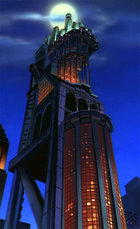 From a design element, it's a quick way for me to let things slide, which is very helpful for me. I've play around in detail with game worlds before, and it's very easy for me to get trapped in minutiae "But if they had riding terriers in the 1200's in Northern Not-England, how would that impact semaphore towers in SOUTH Not-England?!", and from there my brain falls apart trying to make a tight clean world. Having an apocalypse hit and then shove everyone into a cramped spot lets me say "Yeah, history--that was a thing that happened somewhere else" and move on.
On a random note, This is the main mental image I'm getting for the Tower. Good old Xanatos and his "sweet God, this is the most unrealistic skyscraper ever!" A massive, three-mile high tower, one entire face the golds and reds and sapphires of meta-enhanced stained glass, angles and gargoyles along the edges. The Tower should be more than just a big tube that people live in--it should show the beauty and power of mankind. It is a cathedral to survival, and a beacon in the long dark night. It should be a character itself, one more interaction you and your characters will have to deal with.
Finally--it's just cool.
So there is a reason I've done what I've done, and what I want to do with it. I'm fine with "DUDE, AWESOME!!" as a reason to throw something into your game, but I feel you need to be able to explain and defend your choice beyond "Dinosaurs riding Battlemechs!! Why are you asking me about this?!", and preferably use said new awesome idea to make a more entertaining sandbox.
Part the Second: Another thing I really wanted to chat about was what kind of game I want to be able to run with this. For me, there's three major things that I want this game to be able to handle:
1. Pick-up and Play: It's the main reason why I'm including the dungeon crawls. I've talked about the problems of RPG's, and one of the big ones is the time element. A major aspect I want to be able to pull of is that if you and three friends are hanging out waiting for Chad to arrive and GM already, you can roll up a quick four room dungeon, grab some characters, and get fighting.
2. The Summer Blockbuster: One step above level 1, the "Blockbuster" is what I consider the quick two to three session game where we meet characters, have a story, and beat the bad guy/get eaten. In many ways this is my "Play by Post" game--one where we start with our heroes and get going with the fun and the plot, and finish up.
3. The Semester of Awesome: I should have gotten a major in RPG in college (represent Cornell Chess and Game!) with all the gaming I did. Being able to run that long chronicle of awesome, of building up and exploring the world, getting into the deep elements of your character and the world--this is the rare moment that I play games for. It's the strength of the hobby.
Obviously, these things will affect what I expect the game should do, and what should be focused on in the story element. These will impact the mechanics more than the plot, but it is something I want to focus on story-wise as well.
Why did I take a magitek fantasy with politics and culture and cool toys and throw it in Necromunda?
There are actual answers for that.
From a thematic vibe, all mankind stuck in one last tower gives your actions importance. You have to fight off the bad guys because there's no where else to go--just the tower or the ice. There's also the symbolic aspect of it--I love tarot cards for their ability to tap into Jungian shadows, as it were. Tarot cards aren't the core concept anymore, but there's a lot of ideas from the cards that I liked.
From a design element, it's a quick way for me to let things slide, which is very helpful for me. I've play around in detail with game worlds before, and it's very easy for me to get trapped in minutiae "But if they had riding terriers in the 1200's in Northern Not-England, how would that impact semaphore towers in SOUTH Not-England?!", and from there my brain falls apart trying to make a tight clean world. Having an apocalypse hit and then shove everyone into a cramped spot lets me say "Yeah, history--that was a thing that happened somewhere else" and move on.On a random note, This is the main mental image I'm getting for the Tower. Good old Xanatos and his "sweet God, this is the most unrealistic skyscraper ever!" A massive, three-mile high tower, one entire face the golds and reds and sapphires of meta-enhanced stained glass, angles and gargoyles along the edges. The Tower should be more than just a big tube that people live in--it should show the beauty and power of mankind. It is a cathedral to survival, and a beacon in the long dark night. It should be a character itself, one more interaction you and your characters will have to deal with.
Finally--it's just cool.
So there is a reason I've done what I've done, and what I want to do with it. I'm fine with "DUDE, AWESOME!!" as a reason to throw something into your game, but I feel you need to be able to explain and defend your choice beyond "Dinosaurs riding Battlemechs!! Why are you asking me about this?!", and preferably use said new awesome idea to make a more entertaining sandbox.
Part the Second: Another thing I really wanted to chat about was what kind of game I want to be able to run with this. For me, there's three major things that I want this game to be able to handle:
1. Pick-up and Play: It's the main reason why I'm including the dungeon crawls. I've talked about the problems of RPG's, and one of the big ones is the time element. A major aspect I want to be able to pull of is that if you and three friends are hanging out waiting for Chad to arrive and GM already, you can roll up a quick four room dungeon, grab some characters, and get fighting.
2. The Summer Blockbuster: One step above level 1, the "Blockbuster" is what I consider the quick two to three session game where we meet characters, have a story, and beat the bad guy/get eaten. In many ways this is my "Play by Post" game--one where we start with our heroes and get going with the fun and the plot, and finish up.
3. The Semester of Awesome: I should have gotten a major in RPG in college (represent Cornell Chess and Game!) with all the gaming I did. Being able to run that long chronicle of awesome, of building up and exploring the world, getting into the deep elements of your character and the world--this is the rare moment that I play games for. It's the strength of the hobby.
Obviously, these things will affect what I expect the game should do, and what should be focused on in the story element. These will impact the mechanics more than the plot, but it is something I want to focus on story-wise as well.
Wednesday, September 17, 2014
Who are you playing--Batman or Superman?
So I'm pondering Magic, and running into a number of problems due to its sheer size, so expect some rambly diatribes in the near future. So while I really don't want to get too deep into mechanics yet, I need to solidify a few game elements. A big one is "who am I playing?"
The two main types of character I see are Heroic Human and Spell-blooded, or Batman or Superman.
The Heroic Human is the action hero, a fellow that is in many ways a superb bad-ass. He's that "peak human" character, well-trained and talented at what he does. However, he or she will be fighting off monsters from Hell, who are well above his weight class. The Human will need to fight smart, using tactics, waiting for the right moment to strike, and relying on a Caster to give him an edge.
The Caster "mini-game" will essentially be "you have a utility belt of awesome, but can only use x things at a time". As well, Casters give specific boosts--you can't get a +2 to Agility, but you can get a +2 to melee or stealth or... The Caster user will have to balance what they want--do they focus on striking hard, or leave a few tricks for defense up? Will they have time to switch from long-range to melee, or do they trust their shot's going to take down that barn-sized monstrosity? The other issue is going to be that Casters will have access to "low-level" tricks, so they can't rely on brute force. So they're going to have broad low-level abilities at their disposal, and most likely a few "fate points" to modify events.
No, if you want brute force, go Spell-blooded. They're the ones that will have powers and abilities far beyond mere mortals. Ok, probably not Super-man, but closer to mid-to-high level X-men, or Superboy from Young Justice, or Princess Elsa from Enchanted (Hello 6-14 year old demographic!! You've come here by accident I assure you! Please, enjoy this musical number instead! My 4 year old wakes up to it almost daily!! Ohmigawd I can't wait for the sequel!! SQUEEEEEE!).
The advantages of playing a Spell-blooded are they get powers, they get to play with most/all of the elemental powers (No, I don't know what kind yet...), and they can really enjoy super-human stunts. The problem is they're a bit focused--they're going to need to hustle against some of the creatures. They can use casters, but the goal here is to make them ask "why am I wasting time on this?! I could be using these points to be faster, stronger, more alive!!"
Of course, I'm not at all touching the mechanics, so this is all white-paper pie in the sky stuff right now, but for magic I need to know what I expect it to do before I start setting things down. I'll chat more about it all later, but at the very least, those are the two broad families of character concepts I'm hoping to support.
Ponder ponder ponder...
The two main types of character I see are Heroic Human and Spell-blooded, or Batman or Superman.
The Heroic Human is the action hero, a fellow that is in many ways a superb bad-ass. He's that "peak human" character, well-trained and talented at what he does. However, he or she will be fighting off monsters from Hell, who are well above his weight class. The Human will need to fight smart, using tactics, waiting for the right moment to strike, and relying on a Caster to give him an edge.
The Caster "mini-game" will essentially be "you have a utility belt of awesome, but can only use x things at a time". As well, Casters give specific boosts--you can't get a +2 to Agility, but you can get a +2 to melee or stealth or... The Caster user will have to balance what they want--do they focus on striking hard, or leave a few tricks for defense up? Will they have time to switch from long-range to melee, or do they trust their shot's going to take down that barn-sized monstrosity? The other issue is going to be that Casters will have access to "low-level" tricks, so they can't rely on brute force. So they're going to have broad low-level abilities at their disposal, and most likely a few "fate points" to modify events.
No, if you want brute force, go Spell-blooded. They're the ones that will have powers and abilities far beyond mere mortals. Ok, probably not Super-man, but closer to mid-to-high level X-men, or Superboy from Young Justice, or Princess Elsa from Enchanted (Hello 6-14 year old demographic!! You've come here by accident I assure you! Please, enjoy this musical number instead! My 4 year old wakes up to it almost daily!! Ohmigawd I can't wait for the sequel!! SQUEEEEEE!).
The advantages of playing a Spell-blooded are they get powers, they get to play with most/all of the elemental powers (No, I don't know what kind yet...), and they can really enjoy super-human stunts. The problem is they're a bit focused--they're going to need to hustle against some of the creatures. They can use casters, but the goal here is to make them ask "why am I wasting time on this?! I could be using these points to be faster, stronger, more alive!!"
Of course, I'm not at all touching the mechanics, so this is all white-paper pie in the sky stuff right now, but for magic I need to know what I expect it to do before I start setting things down. I'll chat more about it all later, but at the very least, those are the two broad families of character concepts I'm hoping to support.
Ponder ponder ponder...
Tuesday, September 16, 2014
A Brief Primer of History, Part II
The Sun King and the Secret
Four long years had been wasted as Halesworth’s numbers were spread and quietly whispered about in the halls of power. The result was disastrous--pre-Impact histories report wars erupting between former allies, nations cracking down on minorities, senates shut down, military rebellions--the only thing the kings and queens could accept was letting the masses know about the impending doomsday would be a horrible mistake. Anyone who tried to leak the information or talked too openly tended to be bullied, imprisoned, or ‘disappeared’.
In all the chaos it went without notice that his Majesty Lucian the XVIIIth, high king of the Parsilia Empire and her territories, the most powerful man in the world, quietly announced he was going to build a cathedral on the island of Corcansa. Certainly, it was a bit odd--Corcansa was little more than a jutting mountain in the middle of the Northeastern Sea, barren and cold--but nobles had always been eccentric…
However, others began to notice...inconsistencies. The Royal Architect and her entire staff had been assigned to the project. More and more Elemental Engines had been assigned and shipped off to the tiny island--far more than a simple temple would require. The other empires had noticed this and yet...were not responding. No spies, no warfleets, no blockades. In fact, Parsilia had suddenly had an influx of trade from all over the world, even from far-off lands such as Kehoka and Caxuilpha. The Stonemasters guild was suddenly terribly busy everywhere, and there was no way to ignore that the famous St. Boris’s temple was being torn down Eventually, questions were being raised, first in congress halls and eventually even street corners…it became known as the Secret, and it was on everyone’s lips; “What is Lucian building?”
It was kept for nearly a decade, but the secret eventually had to be told. It was finally announced by the Matriarch herself, Constance IVth, on the steps of the Mergence Cathedral. The world was ending...but there was a plan. The coffers of the Holy Shrines and the great Kings and Empires of the world had pooled their resources, and the greatest minds of the age had designed a sanctuary. The Sanctum Solis--the Last Tower. Those that worked to complete it, no matter their lot, would by Matriarchal decree have a place in it, if not for them than their children.
The news fractured the world. For some, it became a clarion call, a way to survive the oncoming darkness. For others, it became a sign of doom. The world fell apart. Wars raged and anarchy reigned, but through it all construction on the Tower continued. During that time we learned more than we ever had about construction--the largest elementals ever summoned were used, new techniques gained and old techniques improved. Still, even with every major empire working together, throwing everything they had at the Great Work, the Tower was still being worked on as Wormwood became a visible blot in the sky, harkening the end of all things.
Finally, at the end, with entire villages and tribes and cities clamoring to get inside, with crops and herds trampling through the halls and anarchy a hair’s breadth away...Impact.
The ground shook and the sky lit on fire, and only then did we close the Gates. After the quakes came the firestorms and then the starless nights. Then came the ash, and then the ice. A year after Impact the Tower was covered a third of the way up with glaciers, and that has continued until today. The base levels haven’t seen natural light in over two hundred years.
After Impact
Perhaps the worst element of live here in the Sanctum is the stagnation of it all. We have waited for two centuries, and there is still no sign of a break in the ice or the weather. It is still impossible to flee the Tower and live. All of humanity, trapped in one last structure. We go through all the motions of life, and yet, as a historian, I am forced to announce to conclude that we have not done more than survive since then. We have enough to survive, but not enough to expand. The Nobility of the Old Empires still rules from the heights of the Tower, the threat of banishment enough to keep the masses in line. For two centuries we have had to ask--are we still loved by Zha? Did the act of one man at the dawn of time truly have to damn our world so thoroughly? Is this the best we can ever be?
Even now, signs of trouble just as dire as the Impact are seen and heard. There can be no denying that the Spell-blooded Curse has struck our families and townships again. Just as in the Siege of Traj, the Stonarva plague, or the Six Princes War, it appears that men and women from all walks of life will suddenly be infused with extraordinary abilities. Just as a comet in the sky, their arrival means bleak tidings--war, death, and plague follow their arrival.
Even worse, we hear whispers that something is here with us. Old legends and childish nightmare tales are told, and people are disappearing. The old words of “demon” and “Sycoraxi” echo through the halls. The nobles and the army may scoff at such tales, but I have seen them with my own eyes! The Dragon-kind stalk the streets of Down Colster! Five witnesses of good standing in community and church sweared they saw a Bleak Angel just a month ago! It is truly the End Times! Judgement has Come, and only if we rise up against the Em--
Your Grace,
This flier was found by our agents three days ago, being handed out at a tavern in Harcord [Mile 2.5, Floor 340, Cell 16, 84 Trout Street). All copies on site were grabbed immediately, and we tracked down most if not all of the rest. It appears to be a historic primer, but obviously is a Trajan horse to deliver slander, heresy, and anti-government rhetoric( burned so as to not hurt your Grace's eyes or demeanor with such vile lies). We found the printer, one Uluf Sebastian Yarrick, and imprisoned him immediately. His press was destroyed, and we are reviewing his Caster missives to see if we can find any other accomplices in his cell.
The Tower Stands, the Empires Reign, Long live the King,
--J
Subscribe to:
Posts (Atom)