Pages

Monday, September 29, 2014

The Creation of the Universe and Other Things We've Messed Up


From Here


The Scroll of Origins states that the universe was made by the Creator Zha for a reason unknown to man. Zha is a being that is inconceivable to us--omnipotent, omnibenvolent, omniscent. All that we do understand is that Zha had a reason to build the universe, and that plan involved making the world and populating it with life and humanity. Like all things that Zha touched, it was perfect.

After crafting the stars, the sun, the world, It graced the world with the Zodacaphim, 21 archangels with the holy duty of watching and guiding the world to its crafted purpose. Finally, It graced the world with humanity, and we spread across the world in a timeless epoch known as the Garden Age.

Whatever the plan was for the world and our people, it was destroyed according to the scrolls by the first murder. Given free will, humanity was free to fall into degredation and sin. When Cal smote his father Ashon with the First Murder, it destroyed the perfection of the Garden Age, and threw the world into darkness.  Death and plague and age came crashing upon the world. Even worse, we had pushed the world away from Zha--if the Creator attempted to walk amongst us now, Its perfection would burn away the universe. Only through dreams and visions and the light of the Sun and the Stars at night would we know Zha's glory, until the day of Judgement when the pure souls would be saved and brought back into Zha's haven.

The Fall impacted the Zodicaphim as much, if not more, than it did the mortal world. Stars fell from the sky, and the zodiac and their angelic overseers fell with them. Where once 21 Archangels ruled the night, now there were great gaps of darkness in the the night. only 10 of the Archangels stayed in their proper place. Of the remaining 11, 5 of them fell to the world and became the Nephili, the Fallen ones. Without their names in the Scroll of Death, they were unable to die, destined to wander the world until it was destroyed by Judgement. As horrifying as they might have been, they were the fortunate of the fallen.

Six of the Archangels fall into True Darkness. Whereas Zha's light was still known to the world (albeit distant), these Six fell into the space outside of Zha's light, a universe of dust, cold, and void. These became the Sycorax, the Damned Angels. Howling in pain and madness in the void, they became the antithesis of Zha, and now wished to destroy the whole universe.

Finally, there were the ten remaining Archangels. Suddenly, they had lose over half of their fellow kind, and suddenly had to pick up the pieces. The Zodacaphim became the Heironophim, the highest angels led by the Sun, doing their best to protect and guide mankind. with so much to do and so little power to do it, the remaining Archangels had to uplift man, teaching us how to read the stars and till the earth and call on the magical elements. The clergy strives to keep manking on the path the Archangels have set, hoping that we may still fulfill the requirements Zha has for us, and wait until the last Archangel Judgement awakens to complete the cycle and destroy all that was imperfect.

Of course, this is all taken from scrolls that are thousands of years old, from multiple authors and cultures and argued meanings of every word used. As the Illuminati are fond of pointing out, this is simply a story used as a basis of culture and temporal power. There is no evidence of a Garden Age, no signs there were ever stars in the long dark stretches of the Zodiac. No one can summon an archangel to ask them questions. No one was there to write this down. Even the fact that there is proof of a creature we call the Dragon exists in a place we call the Darkness that seems intent to destroy everything in our world doesn't prove anything--no one has asked the Dragon if it is a fallen angel or anything else for that matter. Like most great stories and deep questions, the truth and power of it all fall down to faith.

Friday, September 26, 2014

Late night rambling about mechanics and game design (that I shouldn't be doing).

First off, thank you all. We've officially hit 500 hits. Seriously, thanks--seeing that number go up keeps me motivated.

So, I'm not supposed to be working on the game mechanics yet. This is one of my little rules--I neeed to get the world down before I start working on rolling dice and moving chits and spinning the Wheel of Overly-Complicated-Modifiers. This is not how I normally do this (I don't really write games, but designing games has been a hobby for me for a long time...). The reason is simple--every time I start working on game mechanics, I end up trying to make it do everything, which is a terrible plan right now. Add to this that right now my notes for some components are too vague to really do anything with, ala the current notes for God-Blooded:

"Something something half-blood, something something Superboy, something something Spriggan. Awesome."

This is also why I haven't really been able to talk about the Guns that Turn you to Salt (GTTYS's). I originally just had the idea and thought it was cool. Since it was so terribly lethal, I knew I would need a portable warding system for our heroes. That turned into the Caster. However, looking at the concept now, with a bit more plotted with the casters, Then I realized, that not only can the magic system I have in mind just shoot curses, but also elemental blasts, ala the classic "fireball". Now, that didn't quite mesh with what I had with the cursing, so now I have two attacks types, and apparently cursing is better for getting through wards than the blasting, so...

You can see the challenge. I mean, this is in many ways WHY I'm doing this--to see if I can make a game to the point where I can think "I should try to find artists and extra writers and...", But this is why I'm not really focusing on mechanics.

But then again, I can't NOT not focus on the mechanics entirely. I don't have the energy to make a thrilling eight-book series of novels on this thing (yet), and frankly I want to write a game, not a novel. So...I'm thinking about what kind of game I want, and what the mechanics need to support.

I want easy mechanics. I want things that are fast and simple. That's why I know I want a binary skill system--either you have it or you don't. We're not worrying about ranks and levels--if you're a fighter guy, you have melee. The wizard can use a sword if he wants and even say he's good at it, but he's not going to beat the guy with Melee because that guy's not just good, he's awesome at swords. That kind of thing.

But truthfully, part of me just wants to ignore that bit, and just figure out Fate or some other system and just do it. So while I have to ponder the mechanics, the game parts, I also want to keep them out in the shadows, away from the spot light, knowing that I might just ignore them all and just let somebody else do the heavy lifting.

The one thing that I keep asking myself, and focusing on is "Is this idea good game, good story, or both?" This is a big thing for me--one of my little rules. Some ideas are great for a story but make it hard to include in a game logically (see "last of my tribe/moody loners). some things are great for games, but hard to include in a dramatic model (see "Hit Points, and the 'so...am I stabbed or just winded or...?). RPG's need to find both--something that is instantly attention-grabbing, but able to be included in the world in a logical manner as well as make sense for the gaming component. The goal is for both, but I'll settle for good game and decent story, or decent game but good story.

So this is a ramble, but I needed to pace the digital halls and get some of this out. Thanks again for coming by. Please feel free to +1 or comment or let other people know I'm here. Come Monday we'll be seeing either religion or life in the Tower, depending on which is more interesting over the weekend.

Thursday, September 25, 2014

The Four (Five) Pillars of Society


Just because all humanity was saved, doesn't mean the Tower is some egalitarian worker's paradise. Society in the Tower is divided into the four pillars--the Nobles, the Clergy, the Illuminated, and the Laborers. It's not a caste structure by any means--people don't have to be in the caste they were born int, but the odds are heavily stacked against anyone moving from one to another.


The Nobles are the nations and powers that built the tower, most from families that were kings and emperors before Impact. This also represents the Militant arm of culture--most armies are there more to protect against rioters than invasion, but wars have been fought floor to floor, and having a standing army is a sign of prestige. Nobles are all tied together by blood, having noble families, and multiple families make up a Nation, a political alignment based solely on ancient pre-Impact lands. Nations that paid for the Tower got influence and Floors within the Tower, and that control from the very beginning means the Nobles are still highly influential.


The Clergy is primarily the Unified Temples of the Heironiphem. If there's any movement in a person's stars, it will probably be going from the Pillar they were born in to the Clergy. The Clergy are the priests, the book keepers, the advisers, the spell casters and spiritual leaders of the populous. Every floor has a temple, a place where the sick can be healed and a quiet moment of solitude can be found. While technically the Clergy has little power, in truth a rousing sermon can change the course of history.


The Illuminated used to be the mercantile class, the trade houses and sailors and middle class of industry. However, they quickly aligned themselves with the new ideas from the universities and learned thaumaturges and physicists that emerged in the late 15th century. They rapidly became a force to be reckoned with, arguing new ideas and new models of the world. Now a powerful coalition, everyone from the professors and archmages of the High University to the Lift Operators to the travelling caravans of shops strive to find the next deal or the next breakthrough. The Illuminated tend to be radical and ideological in their thoughts, questioning assumptions and pushing for new ideas. This leads them to be disliked by the Nobility and the Clergy, but the Illuminated have a wide variety of tools at their disposal that makes them useful and adaptable.

Finally, the Labor class is (almost) everybody else. Every farmer, rancher, fisherman and tanner and street sweep and everything else in between. These are the silent and struggling masses, easy enough for a careless noble to ignore until it is too late. Technically, the Labor class are the lowest rung of the social Pillars, but in many ways they hold the power. If the Laborers don't do the work, who will? Their sweat and blood is the source of the noble's finery and the Clergy's books and the Illuminated's fine wares.


Which Pillar a character comes from will influence their outlook on life, the resources at their disposal, and the connections they have. While it is somewhat obvious that being Nobility will have more advantages than being a Laborer, there will always be some things that the working class will be able to do to advance their own agendas.

Of course, some people don't quite fit within these molds. There is an unofficial fifth pillar, the one made up of the outlaws and the mad and the desperate and the wicked. These unwanted make up the Vagabonds. People that cannot or will not conform to the classical model of society, they create a wandering nation throughout the Tower, finding the hidden and quiet places where the law doesn't look and sensible people don't go. They create a criminal underclass that may not be able to be represented in any manner in official channels, but...there's always a way to get what you need done when you're outside the law. This unofficial fifth pillar creates a thriving black market and a place for those with no place left.


Game Mechanics: Pillars, Status, & Influence
Pillars, mechanically, would represent social status, resources, and political capital. Instead of dealing with loose change and hard amounts of currency, this Pillar system will allow a quick, abstract way to determine who your character is in society, what they do, and who they can boss around. There would be a small chart like this:
  • NOBLE:               OOOOOOOOOO                
  • CLERGY:            OOOOOOOOOO
  • ILLUMINATED: OOOOOOOOOO
  • LABOR:               OOOOOOOOOO
  • (VAGABOND):   OOOOOOOOOO
Except, you know, better looking. You'd choose one of the Pillars as your primary--this is your place in life. You could then spread points around within the Pillars. Points in your primary Pillar would indicate your Status--higher status means more power. A 7 in Noble might mean a baron, or a bishop in Clergy, or a Mayor in labor, etc. This would give you a rough idea of income, power in society, etc. 

Points spent in other Pillars would be Influence--you might not be part of that group, but you have some favors owed and some friends in high places. Those could be spent for favors or help with some social rolls, that kinda thing. While your Status would be fairly solid, Influence would be spent to get control over other aspects of society. This could become a mini-game of throwing chips at one another and trying to get enough influence to win the current challenge, get new equipment or information, etc.

There's more I can see on this (Noble 7 and Labor 7 have completely different credit limits, as it were), but let me solidify them before I start ranting about it. 

Monday, September 22, 2014

Look at this guy!!

I mean, look at this guy!


Ok, look, Final Fantasy and I have a love-hate relationship. I hate grinding for hours. I have mini-games. I'm indifferent on riding birds. But the one thing they do well is cut scenes. Like the above. I LOVE that cutscene.  When's the last time you felt like you could start a game as a teleporting sword-saint who has so many magic swords he has to keep them in a subspace pocket and he can still use them all!?! Operatically?

This guy is hardcore, which a lot of games punish due to the 'zero-to-hero' element of D&D. But I can't say the desire to be awesome at character creation is original. The thing that's unique to me about this one is--he's got a fairly wide variety of capacity right off the bat. He's got a defense/offensive trait (ie, circle of unrealistically large swords), line of sight teleportation, and the standard superhuman suite of bigger, faster, stronger, and more alive.

That's what I want to play. I want my sword guy to do cool magic too because the mage can also kick ass with a sword. Also, I want to do it in a kick-ass longcoat, possibly with a powdered wig if I'm feeling jaunty. And I want to do all of this while diving into Silent Hill and informing them as a duly designated representative, I order them to cease any supernatural activity and return forthwith to their place of origin or nearest convenient parallel dimension because they picked the wrong plane to invade!

...While operatic fight scene music is cranked in the background. 

Sunday, September 21, 2014

How Enchantech works

Gentlemage Davion is planning to go to the Midnight Floors. This is normally a place unbecoming of his stature, but there are...reasons. To prepare for his trip, he makes sure his Neil & Terry Host 9 Caster is ready, topping off the manaite tank and making sure his Ifrit is ready. His caster has four slots free for discs--one is taken up by his attache, and he loads a physical and metaphysical ward disc, both made of quartz, into their slots. Next, he makes sure to adjust the keypad on his belt so it's in a comfortable, reflexive position for him. The keyboard is in a small piano motif, roughly an octave and a half of keys, going from A to second D sharp. Next, his hexlock pistol--five pounds of mithril and oak, armed with a low-level curse--Davion doesn't plan on killing anybody, and boils all over one's body does tend to limit one's effectiveness. Also, a less lethal curse means a quicker pennance, and since he's not carrying a brace of pistols, faster recharge time means more shots.
His dueling saber is next--a fine blade imbued with Storm sigils. Finally, a few trinkets--a whisp-light, some spectacles with superior night vision, and his normal pocketwatch, et al. Davion is ready to go, and takes the Lift down to the places that never see light...

A few hours into his journey, and Davion is walking the streets of Midnight, trying his best to not draw any attention. Davion is quiet, but his fine long coat is too good for this part of town. Davion realizes he's in trouble when a crackle of black magic slams against his wards. Someone just tried to shoot him!!  He draws his saber with one hand while tapping a few keys on his keypad--suddenly, the blade crackles with purple lightening. A swarm of thugs and thieves comes down the street, ready to attack him. It appears they are desperate indeed, for none of them have wards or casters, and their weapons appear to be vicious-looking farm tools and improvised clubs. Davion draws his hexlock and fires--sweet black smoke pours out of the weapon, and the closest man to Davion suddenly screams as head to toe is wracked with blisters instantly. The hexlock whirs quietly as the penance is performed by the pistol, and Davion scans the remaning six men charging him. With only a few seconds to spare, Davion, taps off a riff of chord strokes on the keypad, changing his warding from metaphysical to physical--he's leaving himself open to hexlock fire, but he's hoping whoever shot at him before only has one and isn't quite ready to hit his friends...

So, that's the bad game fiction part of the story. What did Eric, Gentlemage Davion's player, do?

First, Davion has a level 3 (out of probably 1-5 range) for his caster. That gives him 3 "stones" of spells to play with. His caster also has 5 slots of discs, which are spells directly cast on the user of the caster--normally wards and enhancements. In this case, Davion has a Physical ward, a Metaphysical ward, an Attache (office programs, calendars, etc), and a temperature ward to protect him from the cold halls of Midnight Street. He's got his hexlock, his sword (with Storm sigils), and a few other pieces of equipment--a whisperlight (lighter/lamp combo), some glasses of night vision, etc. 

Eric announces he's going to turn on the Metaphysical ward when he gets down to the streets. He uses one Stone to power the Metaphysical Ward in his caster. 

When combat starts, Davion is surprised, but lucky for him his wards are up. The shot doesn't get a critical, hence Davion isn't hit. He draws his Hexlock and pushes a second stone to power it. He fires and hits, causing one of his attackers to collapse in agony. This also activates his pistol's Penance, the time it takes for the weapon to shake off any bad mojo for using black magic, and making the weapon safe to fire again. The curse Davion's firing has a recast rate of 4--Davion has four rounds before he's gonig to be able to safely fire that weapon again. So--melee! He draws his saber, and puts the stone that was in the hexlock into his saber. The blade has the trait Storm on it, so he can charge it with electrical power, upping damage, increasing odds that the can pass through a ward if he needs to, and making cool "zzzzip" noises when he swings the blade.

The GM tells him he's got six guys coming at him with a variety of crude instruments, and none of them appear warded. He's in melee now, the guy who shot at him has at least a few more rounds before the gun works again, and Davion isn't that great of a fighter. Eric takes the stone powering his metaphysical ward and moves it over to his physical ward slot (sadly you can only have one ward up at a time)--now Davion has some magical armor, and all he has to do is kill six vicious thugs and hope the sniper doesn't get another shot in before he can switch back to metaphyiscal... 


So that's what I'm thinking for the Casters and how they work. Basically, you'll have slotted spells to enhance/defend yourself, tools that will require power from your caster, and the game of dancing back and forth on your cool toys. Did that make sense? Any questions?

Friday, September 19, 2014

The Tower (why?) and the Game (What?)

So a bit of a quick one--kid's been sick, but at least magic is starting to gel...

Why did I take a magitek fantasy with politics and culture and cool toys and throw it in Necromunda?

There are actual answers for that.

From a thematic vibe, all mankind stuck in one last tower gives your actions importance. You have to fight off the bad guys because there's no where else to go--just the tower or the ice. There's also the symbolic aspect of it--I love tarot cards for their ability to tap into Jungian shadows, as it were. Tarot cards aren't the core concept anymore, but there's a lot of ideas from the cards that I liked.

From a design element, it's a quick way for me to let things slide, which is very helpful for me. I've play around in detail with game worlds before, and it's very easy for me to get trapped in minutiae "But if they had riding terriers in the 1200's in Northern Not-England, how would that impact semaphore towers in SOUTH Not-England?!", and from there my brain falls apart trying to make a tight clean world. Having an apocalypse hit and then shove everyone into a cramped spot lets me say "Yeah, history--that was a thing that happened somewhere else" and move on.

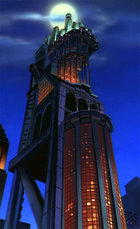
On a random note, This is the main mental image I'm getting for the Tower. Good old Xanatos and his "sweet God, this is the most unrealistic skyscraper ever!" A massive, three-mile high tower, one entire face the golds and reds and sapphires of meta-enhanced stained glass, angles and gargoyles along the edges. The Tower should be more than just a big tube that people live in--it should show the beauty and power of mankind. It is a cathedral to survival, and a beacon in the long dark night. It should be a character itself, one more interaction you and your characters will have to deal with.

Finally--it's just cool.

So there is a reason I've done what I've done, and what I want to do with it. I'm fine with "DUDE, AWESOME!!" as a reason to throw something into your game, but I feel you need to be able to explain and defend your choice beyond "Dinosaurs riding Battlemechs!! Why are you asking me about this?!", and preferably use said new awesome idea to make a more entertaining sandbox.

Part the Second: Another thing I really wanted to chat about was what kind of game I want to be able to run with this. For me, there's three major things that I want this game to be able to handle:

1. Pick-up and Play: It's the main reason why I'm including the dungeon crawls. I've talked about the problems of RPG's, and one of the big ones is the time element. A major aspect I want to be able to pull of is that if you and three friends are hanging out waiting for Chad to arrive and GM already, you can roll up a quick four room dungeon, grab some characters, and get fighting.

2. The Summer Blockbuster: One step above level 1, the "Blockbuster" is what I consider the quick two to three session game where we meet characters, have a story, and beat the bad guy/get eaten. In many ways this is my "Play by Post" game--one where we start with our heroes and get going with the fun and the plot, and finish up.

3. The Semester of Awesome: I should have gotten a major in RPG in college (represent Cornell Chess and Game!) with all the gaming I did. Being able to run that long chronicle of awesome, of building up and exploring the world, getting into the deep elements of your character and the world--this is the rare moment that I play games for. It's the strength of the hobby.

Obviously, these things will affect what I expect the game should do, and what should be focused on in the story element. These will impact the mechanics more than the plot, but it is something I want to focus on story-wise as well.


Wednesday, September 17, 2014

Who are you playing--Batman or Superman?

So I'm pondering Magic, and running into a number of problems due to its sheer size, so expect some rambly diatribes in the near future. So while I really don't want to get too deep into mechanics yet, I need to solidify a few game elements. A big one is "who am I playing?"

The two main types of character I see are Heroic Human and Spell-blooded, or Batman or Superman.

The Heroic Human is the action hero, a fellow that is in many ways a superb bad-ass. He's that "peak human" character, well-trained and talented at what he does. However, he or she will be fighting off monsters from Hell, who are well above his weight class. The Human will need to fight smart, using tactics, waiting for the right moment to strike, and relying on a Caster to give him an edge.

The Caster "mini-game" will essentially be "you have a utility belt of awesome, but can only use x things at a time". As well, Casters give specific boosts--you can't get a +2 to Agility, but you can get a +2 to melee or stealth or... The Caster user will have to balance what they want--do they focus on striking hard, or leave a few tricks for defense up? Will they have time to switch from long-range to melee, or do they trust their shot's going to take down that barn-sized monstrosity? The other issue is going to be that Casters will have access to "low-level" tricks, so they can't rely on brute force. So they're going to have broad low-level abilities at their disposal, and most likely a few "fate points" to modify events.

No, if you want brute force, go Spell-blooded. They're the ones that will have powers and abilities far beyond mere mortals. Ok, probably not Super-man, but closer to mid-to-high level X-men, or Superboy from Young Justice, or Princess Elsa from Enchanted (Hello 6-14 year old demographic!! You've come here by accident I assure you! Please, enjoy this musical number instead! My 4 year old wakes up to it almost daily!! Ohmigawd I can't wait for the sequel!! SQUEEEEEE!).

The advantages of playing a Spell-blooded are they get powers, they get to play with most/all of the elemental powers (No, I don't know what kind yet...), and they can really enjoy super-human stunts. The problem is they're a bit focused--they're going to need to hustle against some of the creatures. They can use casters, but the goal here is to make them ask "why am I wasting time on this?! I could be using these points to be faster, stronger, more alive!!"

Of course, I'm not at all touching the mechanics, so this is all white-paper pie in the sky stuff right now, but for magic I need to know what I expect it to do before I start setting things down. I'll chat more about it all later, but at the very least, those are the two broad families of character concepts I'm hoping to support.

Ponder ponder ponder...

Tuesday, September 16, 2014

A Brief Primer of History, Part II

The Sun King and the Secret
Four long years had been wasted as Halesworth’s numbers were spread and quietly whispered about in the halls of power. The result was disastrous--pre-Impact histories report wars erupting between former allies, nations cracking down on minorities, senates shut down, military rebellions--the only thing the kings and queens could accept was letting the masses know about the impending doomsday would be a horrible mistake. Anyone who tried to leak the information or talked too openly tended to be bullied, imprisoned, or ‘disappeared’.


In all the chaos it went without notice that his Majesty Lucian the XVIIIth, high king of the Parsilia Empire and her territories, the most powerful man in the world, quietly announced he was going to build a cathedral on the island of Corcansa. Certainly, it was a bit odd--Corcansa was little more than a jutting mountain in the middle of the Northeastern Sea, barren and cold--but nobles had always been eccentric…


However, others began to notice...inconsistencies. The Royal Architect and her entire staff had been assigned to the project. More and more Elemental Engines had been assigned and shipped off to the tiny island--far more than a simple temple would require. The other empires had noticed this and yet...were not responding. No spies, no warfleets, no blockades. In fact, Parsilia had suddenly had an influx of trade from all over the world, even from far-off lands such as Kehoka and Caxuilpha. The Stonemasters guild was suddenly terribly busy everywhere, and there was no way to ignore that the famous St. Boris’s temple was being torn down  Eventually, questions were being raised, first in congress halls and eventually even street corners…it became known as the Secret, and it was on everyone’s lips; “What is Lucian building?”


It was kept for nearly a decade, but the secret eventually had to be told. It was finally announced by the Matriarch herself, Constance IVth, on the steps of the Mergence Cathedral. The world was ending...but there was a plan. The coffers of the Holy Shrines and the great Kings and Empires of the world had pooled their resources, and the greatest minds of the age had designed a sanctuary. The Sanctum Solis--the Last Tower. Those that worked to complete it, no matter their lot, would by Matriarchal decree have a place in it, if not for them than their children.


The news fractured the world. For some, it became a clarion call, a way to survive the oncoming darkness. For others, it became a sign of doom. The world fell apart. Wars raged and anarchy reigned, but through it all construction on the Tower continued. During that time we learned more than we ever had about construction--the largest elementals ever summoned were used, new techniques gained and old techniques improved. Still, even with every major empire working together, throwing everything they had at the Great Work, the Tower was still being worked on as Wormwood became a visible blot in the sky, harkening the end of all things.


Finally, at the end, with entire villages and tribes and cities clamoring to get inside, with crops and herds trampling through the halls and anarchy a hair’s breadth away...Impact.


The ground shook and the sky lit on fire, and only then did we close the Gates. After the quakes came the firestorms and then the starless nights. Then came the ash, and then the ice. A year after Impact the Tower was covered a third of the way up with glaciers, and that has continued until today. The base levels haven’t seen natural light in over two hundred years.


After Impact
Perhaps the worst element of live here in the Sanctum is the stagnation of it all. We have waited for two centuries, and there is still no sign of a break in the ice or the weather. It is still impossible to flee the Tower and live. All of humanity, trapped in one last structure. We go through all the motions of life, and yet, as a historian, I am forced to announce to conclude that we have not done more than survive since then. We have enough to survive, but not enough to expand. The Nobility of the Old Empires still rules from the heights of the Tower, the threat of banishment enough to keep the masses in line. For two centuries we have had to ask--are we still loved by Zha? Did the act of one man at the dawn of time truly have to damn our world so thoroughly? Is this the best we can ever be?


Even now, signs of trouble just as dire as the Impact are seen and heard. There can be no denying that the Spell-blooded Curse has struck our families and townships again. Just as in the Siege of Traj, the Stonarva plague, or the Six Princes War, it appears that men and women from all walks of life will suddenly be infused with extraordinary abilities. Just as a comet in the  sky, their arrival means bleak tidings--war, death, and plague follow their arrival.


Even worse, we hear whispers that something is here with us. Old legends and childish nightmare tales are told, and people are disappearing. The old words of “demon” and “Sycoraxi” echo through the halls. The nobles and the army may scoff at such tales, but I have seen them with my own eyes! The Dragon-kind stalk the streets of Down Colster! Five witnesses of good standing in community and church sweared they saw a Bleak Angel just a month ago! It is truly the End Times! Judgement has Come, and only if we rise up against the Em--


Your Grace,
This flier was found by our agents three days ago, being handed out at a tavern in Harcord [Mile 2.5, Floor 340, Cell 16, 84 Trout Street). All copies on site were grabbed immediately, and we tracked down most if not all of the rest. It appears to be a historic primer, but obviously is a Trajan horse to deliver slander, heresy, and anti-government rhetoric( burned so as to not hurt your Grace's eyes or demeanor with such vile lies). We found the printer, one Uluf Sebastian Yarrick, and imprisoned him immediately. His press was destroyed, and we are reviewing his Caster missives to see if we can find any other accomplices in his cell.


The Tower Stands, the Empires Reign, Long live the King,

--J

Saturday, September 13, 2014

A brief Primer of history, Part I


A primer of the history of mankind, how we built the Sanctum Solari and fled to in the the Dark Days, and a reminder of the glorious future we pray for, by Reginald Thrane XIIth, Written 79 years after the Closing of the Gates


There are eight of our many libraries devoted solely to keeping the histories of our people, each holding many thousands of books and scrolls. There are even more tomes dedicated to matters spiritual and theosophical, so this minor primer should be deemed nothing but a drop of the water of Knowledge to a man dying of thirst.


Regardless, it is truth that Man once lived outside the Tower walls, and in a world much different than the one I see through the glass pane. Where today now stands a never-ending field of ice, miles high, this was once the island of Corcansa, surrounded by warm seas and a forest of green. There were trees and hills and mountains, so many things that I fear my children will never understand. Already the Clergy debate if it will be possible to read the Scrolls in a way for our future generations to understand…I digress.


The short shrift is this--The world was once ours, and we explored, we conquered, we expanded. The Old Empires were made with blood and fire and steel. We expanded our knowledge of the world and the heavens. Yes, there were wars and plagues and famines, political unrest and revolutions, but the world was warm and ours to shepard. It was a Golden Age--but like all Ages, it was destined to fail.


Wormwood
We had always watched the stars, but mankind had been scientifically studying them in earnest for 200 years prior to Impact. We have learned how to map the stars and observe with telescopes, letting us see faraway planets and the stars. scores of scientists and astronomers delved the night sky, looking for secrets. Of them all, Lord Halesworth of Coldoon was one of the most talented and recognized geniuses of the age. He was researching comets in the night sky, the mysterious visitors known as harbringers of doom. Studying the ancient records, he realized one comet continued to return to our skies every 88 years, and the one that hovered over Coldoon’s towers that night would return again in 1748.

If Lord Alton Halesworth had only been able to predict his comet would return to the night sky in 88 years, it would have been enough to enshrine his name in the annals of history. However, it was his genius to deduce what would happen when it arrived that granted him sainthood. It took him three years before he was positive, and he shook as his numbers gave him a dire prediction--when the Comet came back this time, it would not pass through our skies, but instead crash into the world. The forces were incomprehensible--it would boil sea and burn sky. Halesworth’s warning was fought and debated, but in the end the wisest scientists and sorcerers agreed--in 88 years, all life on the planet would be killed.

Friday, September 12, 2014

Ten Things I expect you can do in this game:

Real quick one, but important:

1. Hell-spelunk: There are reasons for why I want “dungeons” for you to raid that I’ll get into later, but the short of it is this--it’s a quick way to jump into a game. “The forces of Hell are coming out of that portal--go stop it!!”
2. Do awesome stunts: I want flying, teleporting, car-chucking heroes.
3. Fight off a horde of monsters: I want you to be outnumbered and outgunned...and grinning.
4. Pull of impressive, creative magic: Yeah that’s...a lot. We’ll deal with that later.
5. Summon Angels: Call down some cool pokemons turned to 11 to help you out.
6. Play the Caster mini game: As you can see below, Casters have a lot of options. I want this to be part of the game--you have to choose what you want your support to be at the time.
7. Find arcane secrets: Delve deep into the world, find secrets, and use them for fun and profit.
8. Make dramatic scenes: Probably closer to “drunk Dr. Who” that “Shakespeare”, but I want your characters to have to impress and talk their way out of (and into) problems. This isn’t just a board game, and the politics should be a possible driving factor.
9. Add your own touches: I’m picturing this as an open world--I’m giving you sets and some character guidelines, you can fill in the details.
10. Be a hero: Part of this is mechanical as well, but I want a game where you can feel like you’ve hit above your weight class and can scream “YES!” on a really good roll.


I know, I’m not really working on a game system for it, but since this IS a game I need to play a bit with what I want as a game to make sure the “fluff” matches up. Sooo...what do you want to do? What did I miss?

Wednesday, September 10, 2014

The Miracle of Casters: Technology and Magic Working Together


The Caster (technically a Spell-Casting Engine) was what brought magic from a hobby to an industrial revolution. As any teacher can tell you, sorcery--the bending of telluric energy from the ethereal realms--is a natural component of the universe, and like heat or light or electricity, is a force that can be measured, tested, and utilized. However, eldritch is harnessed not by material properties but spiritual ones--specifically, the interaction of a human soul via symbols we know as Angelic Runes. To bring a person into the right mindset naturally, however, required long and complex rituals that were expensive both in time and material, and due to the stress involved, unreliable and hazardous to the magician.
It was Jarvis of Bishara that first invented the Caster in the 13th Century (using, it must be noted, the works of Lakri the Red’s “enclosed universe” theory as inspiration). The machine was simple--a basis of the old efreet lanterns. He summoned an air elemental and encapsualted it in a box the size of an elephant according to the ancient records. Inside the box was a simple ritualistic circle--in this case, a musical number played by phantom instruments. The song was played backwards and much too slowly, but the results were undeniable--instead of taking days, it had taken hours, and it worked.


The theory of the caster is straightforward--take a summoned elemental and place them within a warded container. Give them a stead supply of eldritch energy via the glowing blue concoction known as manite to keep them ‘fed’ and ‘happy’, and then use a 'riteware', a ritual carved on a disc of gold, mithrill, or other appropriate mineral to “shape” the elemental into the spell. The elemental does all of the work of casting the spell, and it is then channeled through the user (that is, the person using the caster) and the spell is cast. Instead of hours or days, it takes seconds.


Casters require an ifreet, eldritch energy to cast the spell itself, and a living soul to act as the conduit between the virtual universe and the real world. They range in size from massive room-sized industrial casters to the popular personal caster. The larger the caster, the larger the elemental that can be summoned and the more complex ritual that can be programmed. It was this technology that allowed the Tower to be built in the first place, and it is this technology that allows a modern gentlemage to keep him (or her)self warm, safe, and stylish.


Personal Casters can (with the proper riteware) protect a wearer from the elements (and Elements), create simple illusions, modify the senses (such as superior night vision), improve health and well-being, and perhaps most popularly protect the wearer from physical or metaphysical damage. The biggest difficulty is normally not having enough mana to run all of ones rites simultaneously.

The creation of the Personal caster changed everything, especially in relation to war. First, troops could survive getting to the combat easier. Secondly, a trooper with the simplest caster and a warding circle became effectively invincible against physical damage. Some praised this would end war forever, but they underestimated mankind’s capacities for problem-solving and violence...

Monday, September 8, 2014

What be this 'Baroque-Punk'?

So this was a blog I made way back when, and while I had a few things to say, I never really felt that confident in it. Then this...idea weaseled into my brain. I had to get some things out. I had to tell people about...Baroque-Punk.

It was everything I wanted in a game. It had magic and high tech and terrible threats and a corrupt government and bad-ass humans and bad-ass better-than-humans. It was a world in a single location so I didn't get stuck in a sprawling morass of history. It was after an apocalypse but before another, worse apocalypse. It had style and a sense of swashbuckling and humor, all while dealing with horrific nightmares that had to be stopped. It was a world by and for big-ass heroes who could do stuff because it was A.) awesome!! and B.) Made sense for the game world. Also Awesome.

So first, the main thematic ingredients:
Baroque: Specifically, the elements of style and politics from the 17th and 18th century. The revolution of science and philosophy, politics and social orders were all shook during this period. I feel it's a perfect age for 21st century gamers in terms of a 'fantasy' world--it's still got swords and kings, but it also has mad scientists and revolutions just on the horizon. 

Magi-tek: I love magic in my games. I love cool technology, but getting the two together has always been hard for reasons I may one day get into more depth on. Nine times out of ten it seems like magitek quickly becomes "a Ford Taurus, but powered by MAGIC!!", where the wonder and terror of sorcery gets blunted by mass industrialization. I hope to make something a bit more lively, but for now let's just say this--this world will have powers based on metaphysics, but be used in a rational and physical way. It's science based on elements and deamons and angelic script, all being used in rational and industrial ways. 

My quick example--the standard side-arm won't just kill you, but turn you into salt.*

Heroes and Monsters, and the blending thereof: I want a world in danger so you can save it. I want monsters that you hate, heroes that become terrible doing the right thing, and villains you can empathize with their beliefs (which makes you want to stop them even more). I wanted a way for both brilliant "regular" humans and supernatural demigods to fight side by side.

So we take all of those things and blend, sticking in a super-fantastic arcology, and sprinkle in my favorite things. 

So here's The Plan: I hope to post here at least once a week with some information, some tidbits, some background or game philosophy. The main goal here is to take one thing off my bucket list--make a really great RPG. The main focus right now is to just make a world, and if you want to play in it, great. I'd like to build a system to work with the world, but right now I'm trying to keep myself focused on the setting first.

What I need from you? Let me know what you like. Let me know what could be more awesome. Let me know you're reading this. 

There's this world I'm building, and I want you to come play in it...


*Those of you that just said "COOOL!"....you're who I'm making this game for.

Sunday, September 7, 2014

The Beginning

The Sanctum Solis. The Tower. The greatest work of man and elemental, and the last hope for mankind.

Once, we lived outside these walls and throughout the world.  From the clerics, we learned faith and willpower. From the sorcerers we learned how to call on the Elemental powers, to tame and harness nature. From the scientists, we learned of optics and physics and mathematics. Only with each were we able to see the doom that was coming for our planet--the meteor called Wormwood, the destroyer of Life as foretold in the ancient scrolls of Judgement. The meteor came like clockwork every 88 years, but Doctor-Saint Halewood warned us that this time...it would impact. The scientists and thaumaturges checked and cross-checked the mathematics, and in the end the estimates were dire--the world would be plunged into fire and ice. Nothing could survive the impact...

The greatest minds of every empire came and with blood and sweat and gold and elemental, we did the impossible. We carved a mountain into a great temple of man--one that would allow us to wait out the Long Cold. We created the Sanctum Solis, and when the skies burned and the waves turned to ice, we waited inside…

For two hundred years, we’ve survived. Inside these walls we have everything we need--food, water, life. For two hundred years we thought we were safe. Then the signs started...first came the Spell-blooded, the children of Anoch, children that were touched by angel or devil. Able to naturally harness the powers of sorcery, they have always been a sign that darkness is coming.

Then the Gates appeared. Boiling out of the walls like cancer, and from the gates the Legions of the Demon Kings themselves. The Clergy point out that these are signs of the end times, as foretold in the Scroll of Endings. Our most valuable commodity, hope, begins to fade…

The great Sun King Albrechti Xahua has declared the Spell-blooded to be used to fight the Nightmare Armies. We will use the people we fear to destroy the enemy at our gates. They, along with other brave souls, will save us from Apocalypse or die trying.

We are all that is left of the world. If the Archangels hear our prayers we shall be victorious and build a new one. If we fail, than we shall make sure that the Angel of Judgement never forgets our names as we carve them into his chest...

Friday, September 5, 2014

Let's Look at Arts and Realms...

Why?

Why did they do the Arts and Realm split like they did? Well...I don't know. I wasn't at the meetings. But from what I can read between the lines, there was a definite goal to it.

First and foremost, to represent the difference between fae and the other races. Vampires had a straight line of powers. Werewolf had a swiss army knife--a huge mass of very limited options that you could pick and choose, almost Vancian in its applications. Mages were the big boys--you bought huge swaths of control over fundamental things. It also spun the world and powers out of control, I think, but...

But Changelings. They're magical creatures, right? There made of belief, of creativity (right Tink?). So they needed a magic system that was creative. The concept of using X abililties on Y things only was a great concept. But...

First, OWoD never felt like they really playtested the powers to me--or at least, they played in a way that wasn't like I played (see the Transylvania chronicles last of a bloodline: "We're sure your players will be slavering over the many demands for this little lady..." No. I'd prefer to protect her, if you don't mind...). This gave us newbie mages turning antedeluvians into lawn chairs and the fact that four starting changelings can destroy Sam Haight.

Second, the descriptions were odd. My rewrite of Nature I think leads down a fairly progressive path. The realms were strange, the arts were sometimes poorly written, and worst of all, some of the powers (create element) were there for filler.

What's my beef with create element? Simple--everyone's got that power. Werewolfs, Changelings, Mages, even a good Tremere can make earth, air, fire, water. Now seriously--most PC's only make fire. Secondly, it's not magic because everyone can do it. It felt like this would be the test in WoD if you were a REAL supernatural: "You wanna join the club, huh? fine--fill this bucket with elements, bub!"

As for the Arts--they're fine, but it always feels like they were a bit limited by other factors in the WoD, even though you weren't supposed to play with the other kids (like anybody followed THAT rule). You couldn't have Changelings be as obviously powerful as the Mages!! You couldn't have a Redcap be as terrible or a Brujah or a Silver Fang!! You just COULDN'T!!

Well, I don't have that problem...